
Sindh Govt Announced Rs 3000 Stipend For Children
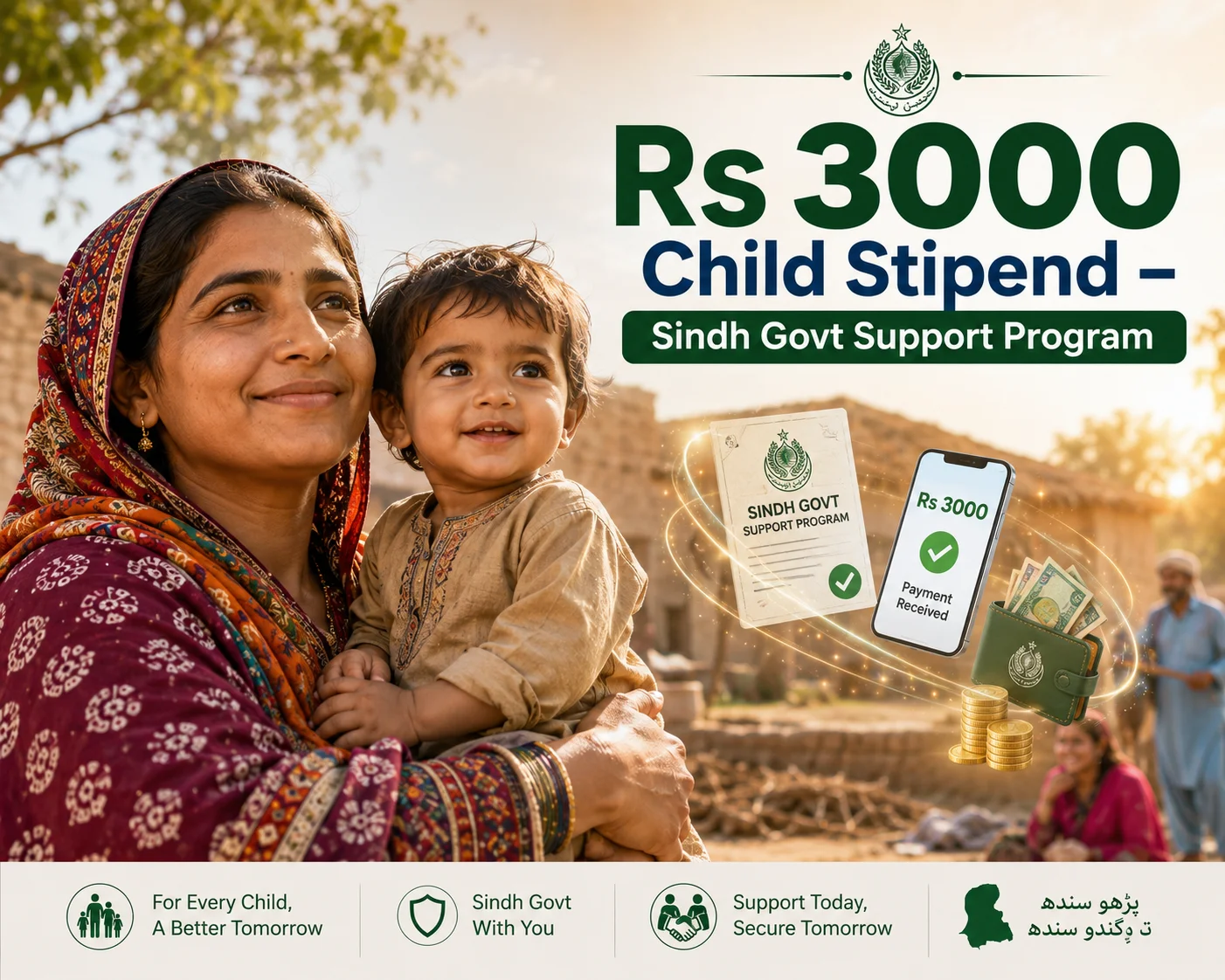
Sindh Govt Announced Rs 3000 Stipend For Children
Sindh Social Protection Authority (SSPA)
The Sindh government has expanded social protection through the Sindh Social Protection Authority (SSPA) by introducing a financial support program for children from birth to 5 years and those under five. During the 3rd board meeting, Chief Minister Syed Murad Ali Shah approved several welfare measures to improve child welfare, maternal health, nutrition, and health services across the province. From my experience following welfare reforms in Pakistan, programs that combine financial support with healthcare often create better long-term outcomes for families.
The initiative strengthens existing social welfare and social welfare initiatives by supporting vulnerable families living in rural areas, especially rural women. The Early Childhood Development, ECD Program, Mamata Program, Mamata Maternal Health Cash Transfer Program, Women Agricultural Workers Program, and Mamata Desks have all been introduced as flagship programs to improve protection for young children and increase the number of beneficiaries receiving the quarterly stipend of Rs3000 (Rs 3,000).
Program Reference
The table below highlights the major Program component and funding details approved by the government.
| Program / Component | Key Details |
|---|---|
| ECD Stipend | Rs3,000, Rs 3,000 per quarter, quarterly stipend per child from birth to 5 years |
| Funding | Rs14 billion |
| Collaboration | German agency, KfW |
| Beneficiaries | Around 885,000 children, rural women, and other beneficiaries |
| Mamata Budget | Rs56 billion |
| Coverage | 22 districts |
| Mamata Registered | Over 1 million beneficiaries |
| Fiscal Allocation | Fiscal Year 2026-27 with Rs2.29 billion allocation for welfare initiatives |
| Expansion | Urban expansion study with the Gates Foundation covering Karachi and Hyderabad |
| New Coverage | 7 new districts with central Mamata desks |
This investment shows that the government is focusing on long-term child development instead of one-time relief. The partnership with the German agency KfW, support from the Gates Foundation, and expansion into Karachi, Hyderabad, and new districts indicate that the program is designed to reach more deserving families while improving service delivery across Sindh.
Eligibility Criteria for the Rs 3,000 Child Stipend
The government has introduced clear Eligibility, eligibility criterion, beneficiary eligibility, and stipend eligibility rules to ensure assistance reaches deserving families. Under the ECD Program, children birth to 5 years and children under five living with rural women are the primary beneficiaries. The Mamata Program mainly supports pregnant mothers, while the Agri Workers initiative focuses on agricultural workers. Depending on the program, eligible families may receive a quarterly cash disbursement, monthly cash assistance, or another form of cash transfer.
The government has also planned maternal support by linking different welfare schemes with healthcare services. Although urban coverage is still under review, planned expansion studies will determine future inclusion. The overall feasibility of each program is being assessed so that financial support reaches the right beneficiaries without unnecessary delays.
District Coverage & Budget
The government has expanded the program across multiple regions with a dedicated District coverage and budget plan. The Mamata Program is already operational in 22 districts, backed by Rs56 billion, while Mamata Expansion has been approved for 7 new districts. Several existing districts will continue receiving services, and newly approved areas will gradually become part of the welfare network.
A study approved for Karachi and Hyderabad will evaluate urban feasibility, while the ECD Program remains active across province-wide rural Sindh with Rs14 billion in funding. The Agri Workers Program has also been included in the total plan, supported through an additional Rs2.29 billion allocation.

How the PPM Payment Model Works
The PPM Payment Model has been designed to make payments more organized and transparent. It begins with Mother registration at a Mamata Desk located in a district headquarters hospital or taluka headquarters hospital. After verification and eligibility verification, officials confirm rural residency, pregnancy, or a child under 5 before approving assistance. Once approved, the full cash disbursement starts to support the youngest child throughout child development.
The payment process follows a fixed schedule, where families attend a medical examination and health visit before receiving the next installment. Under the revised model, 75% conditional cash assistance continues until the eldest child reaches two years of age. Regular audit review, oversight review, and monitoring by the legal committee, audit committee, and research committee help ensure transparency and accountability.
Governance Committees
To strengthen accountability, several governance bodies have been established, including the Audit Committee, Legal Affairs Committee, Human Rights Committee, Research Committee, Human Resources Committee, and the Monitoring & Transparency Unit. Together, they improve governance, provide continuous oversight, maintain financial transparency, supervise fund disbursement, and ensure regulatory compliance through a strong legal framework.
These committees also safeguard beneficiary rights, promote equitable access, conduct program monitoring, support evidence generation, and oversee staffing, training, and capacity management. Their work helps improve payments and overall service delivery, making the welfare system more reliable for deserving families.
Old Payment Model vs New Hybrid PPM
The Old Payment Model often resulted in unpredictable disbursement, creating irregular cash flow for families and making household budgeting difficult. The New Hybrid PPM introduces a fixed schedule linked with medical visits, health checkups, and examination attendance so beneficiaries receive payments on time. This improved Hybrid PPM also considers the child age, with 75% conditional support continuing until the eldest child reaches 2 years.
To improve accountability, the audit committee monitors fund disbursement, increases transparency, strengthens the overall governance structure, and helps ensure timely release of funds. These payment reforms are intended to reduce delays and build greater trust among beneficiary families.
All Programs Compared
| Program | Target Group | Payment Type | Amount / Support |
|---|---|---|---|
| ECD Program | children 0–5 years | quarterly stipend | Rs3,000 per quarter |
| Mamata Program | pregnant mothers | Hybrid PPM | full payment + 75% conditional |
| Agri Workers Program | rural women | monthly cash | Seasonal support |
| Social Protection Program | vulnerable households | seasonal cash | Based on the agricultural cycle |
Each scheme serves a different target group, but together they provide financial assistance through different payment type options. This combined approach helps improve financial security for children, mothers, and rural families across Sindh.
Implementation Risks
Although the program has strong potential, several challenges remain. Payment delays and irregular disbursement can reduce beneficiary trust, while missing health visit incentives may affect participation. Urban exclusion could leave backward urban areas in Karachi and Hyderabad without proper support. Likewise, weak registration at a Mamata Desk may delay enrollment, causing eligible mothers to miss financial assistance.
Other concerns include the seasonal gap faced by agricultural women during Oct–Jan, increasing the risk of debt, malnutrition, and food insecurity. The government must also address governance gaps, strengthen committees, maintain proper audit trails, prevent fund misuse, reduce nutritional lag, improve counseling outcomes, achieve ECD health goals, and ensure every cash transfer reaches deserving families.
CM’s Commitments
The government has promised a Reliable support system with structured payments for the poorest families across Sindh. Its focus is on sustainable welfare, long-term investment, and human investment that improves social protection for mothers and children. Special attention will continue for rural focus, hard-to-reach areas, and agricultural women.
The strategy also connects health, nutrition, health visits, and nutritional counseling with financial assistance to improve family well-being. By promoting financial stability, debt reduction, lower food insecurity, resilient families, stronger communities, and a healthier future, the government hopes to create lasting social benefits.

Rural Women Support During Non-Productive Periods
The new support package also targets Rural women during non-productive agricultural periods, when household income is usually at its lowest. Through monthly financial cash transfers, the government aims to reduce economic vulnerability and food insecurity during the coverage period, especially in low income months and non-productive seasons.
This assistance addresses dependency and financial exclusion while strengthening welfare support and provincial welfare programs. The assistance type has been designed around practical primary goals, with regular oversight to ensure the funds reach deserving women.
Mamata Desk Establishment Details
Every Mamata Desk will operate from district headquarters hospitals and taluka headquarters hospitals across Sindh. These centers will handle beneficiary registration, on-site registration, provide support services, and offer counseling for mothers and children. The expansion has been approved by the SSPA Board under Chief Minister Syed Murad Ali Shah.
The government also plans urban expansion through central Mamata Desk facilities in 7 approved districts. Working with the Gates Foundation as its collaboration partner, the project will improve services in backward urban union councils and expand access for eligible families.
FAQ’s
| Question | Answer |
| Who can receive the stipend? | Eligible caregivers and eligible families with children birth to 5 years, including 1 month to 5 years old children living in Sindh and rural areas. |
| How much is the payment? | Families receive Rs3,000 as a quarterly payment made every three months. |
| What is the purpose? | It supports child growth monitoring, nutrition counseling, and school readiness. |
| Is it part of BISP? | No. Although many compare it with the Benazir Income Support Programme (BISP), it is managed by the Sindh Social Protection Authority (SSPA) under the Early Childhood Development ECD project and the Sindh Social Protection Program. |
| How can parents apply? | Parents should wait for official registration through announced registration points and then parents apply according to government instructions to receive financial support under the stipend program. |
Lasting Impact of the Sindh Child Support Initiative
The Sindh government has introduced a policy announcement that strengthens social protection and social welfare across the Sindh province. By expanding financial assistance for children, improving health, supporting nutrition, and investing in early childhood development, the government is creating a more cohesive framework for long-term child development. From my observation of similar welfare programs, combining financial support with health services usually delivers more sustainable results for families.
Through the SSPA, the Mamata Program, and the ECD initiative, the province aims to improve welfare delivery for vulnerable citizens, particularly rural women and young children. The success of this initiative will depend on effective implementation, but if managed well, it has the potential to become a national benchmark for social welfare and create lasting change for future generations.


