
CM Punjab Rahmat Card Registration Process 2026
The CM Punjab Rahmat Card Scheme 2026 is a flagship social welfare program personally launched by the Government of Punjab under Chief Minister Maryam Nawaz Sharif. Operating under the philosophy of Sarkari Kafalat — or State Patronage — this initiative is managed by the Punjab Social Protection Authority (PSPA) with one clear mandate: deliver sustainable financial assistance to the most vulnerable segments of society, especially widows and orphaned children who have lost their primary earning member or breadwinner.
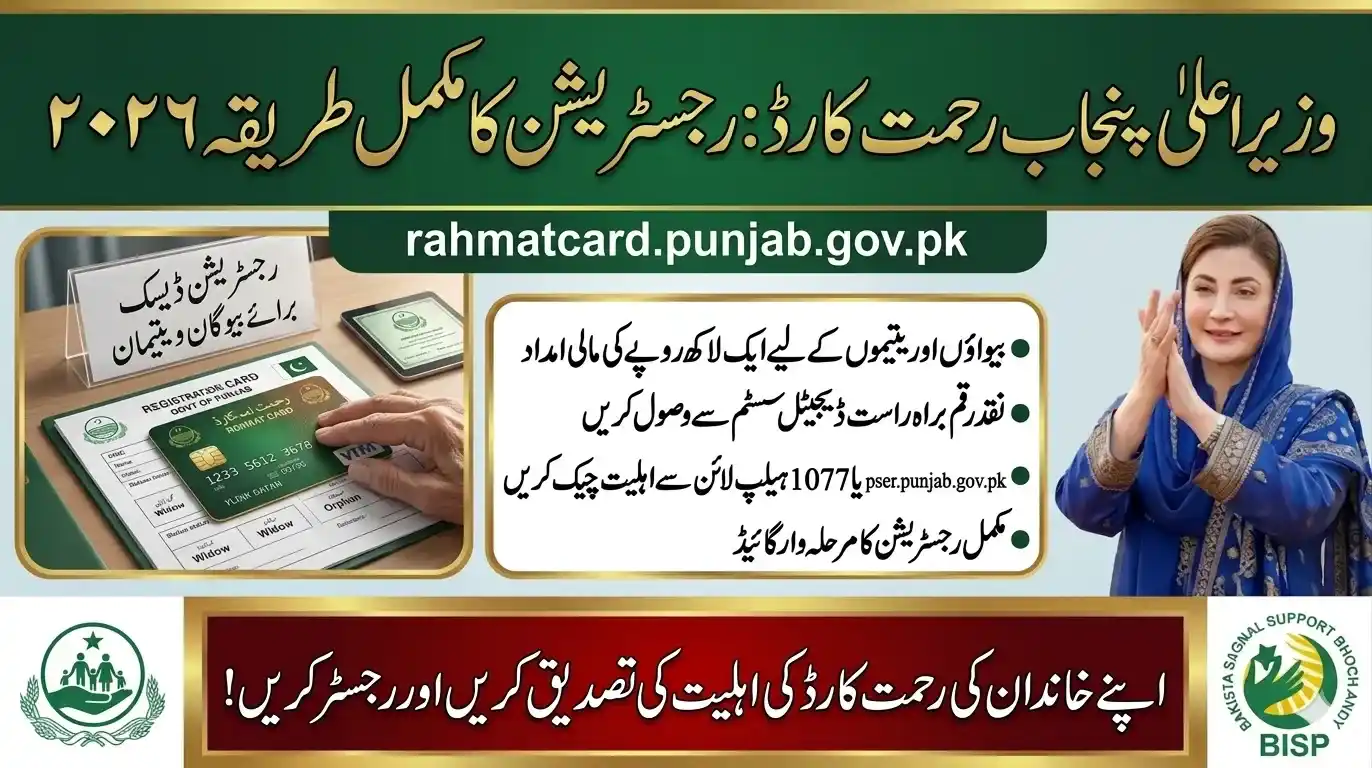
What makes this scheme stand out from previous relief efforts is its structured, dignity-first approach. Rather than scattered handouts, the Maryam Nawaz welfare scheme channels substantial one-time financial grants directly to deserving families, helping them cover household expenses, children’s education, healthcare, and daily needs — genuinely moving people toward becoming self-sufficient. Having closely followed Punjab’s social safety landscape, I can say this is one of the more thoughtfully designed programs in recent memory. The Bewa Sahara Card covers the widow support component, the CM Punjab Yateem Card handles orphan children support, and together they operate under the Rehmat Card umbrella program.
Beyond cash, the broader welfare vision behind this welfare initiative connects to other programs like the Himmat Card for persons with disabilities and Apni Chhat Apna Ghar, a housing program designed for low-income families. In its first phase, the scheme targets 50,000 families across Punjab, offering direct financial support through transparent verification via government databases — making it a true lifeline for financially weak families struggling with quality of life and daily expenses.
Key Highlights CM Punjab Rahmat Card
The CM Punjab Rehmat Card — also branded as the Bewa Sahara card was launched by the Government of Punjab under Maryam Nawaz Sharif to serve widows, orphans, and other deserving families facing financial hardship. The widow grant stands at Rs. 100,000 as a one-time payment, with per child support of Rs. 25,000 per orphan child, and a maximum support cap of Rs. 150,000 per family. In Phase 1, the program coverage extends to 50,000 families, backed by a budget allocation of Rs. 5 billion.
From a practical standpoint, the scheme is highly accessible. Registration methods include an online portal, a mobile app, and physical Zakat & Ushr offices spread across the province. The managing authority — PSPA and the Zakat & Ushr Department — oversees the entire pipeline, while the official portal at rahmatcard.punjab.gov.pk serves as the primary digital gateway. For support, applicants can reach out via helpline numbers 1077 and 0800-02345 from anywhere in the province of Punjab.
What truly sets this apart is its backend integrity. Targeted assistance flows only to Zakat-eligible widows and orphans, verified through PSER and NADRA databases. Merit-based selection eliminates favoritism, while biometric-enabled payments ensure secure disbursement directly into bank accounts or digital wallets — with options for quarterly or bi-annual installments. The digital access layer, including web portal, mobile application, and helpline, makes this genuinely inclusive for all applicants regardless of technical literacy..
Who Launched the Rehmat Card Scheme?
The Rehmat Card Scheme was formally announced under the concept of Sarkari Kafalat — State Patronage — as part of Chief Minister Maryam Nawaz Sharif’s ambitious 100-day agenda after assuming office. Rooted in addressing the economic hardship of widows and orphans across Punjab, the scheme targets families that lose their primary earning member or breadwinner and are left without any safety net. The Punjab Social Protection Authority (PSPA) serves as the main implementation body, while the Punjab Socio-Economic Registry (PSER) handles poverty data verification and eligibility assessment.
The institutional architecture behind this program is genuinely impressive. The Punjab IT Board manages the entire digital infrastructure, including the Rehmat Card web portal and mobile app. Payment flows through the Bank of Punjab and HBL, both offering card and branch-based disbursement. On the ground, District Social Welfare Offices provide on-ground registration support, while District Zakat & Ushr Offices function as alternate in-person registration points. Meanwhile, NADRA handles identity and death certificate verification — the backbone of eligibility confirmation.
Together, the Bewa Sahara Card for widows and the Yateem Card for orphan children form a comprehensive two-component system of economic empowerment — a defining achievement of the current Punjab government that goes well beyond symbolic gestures.
Objectives of the Program
At its core, this program exists to deliver meaningful financial assistance to Zakat-deserving widows and double parent orphans — those who are completely parentless — with no strings attached. The deeper goal, however, is economic empowerment, helping recipients rebuild self-reliance and reclaim their social dignity within their communities.
Every rupee disbursed under this scheme is governed by a commitment to transparent, fair, and merit-based utilization of Zakat Funds — ensuring that public trust is never compromised.
Rehmat Card Scheme Latest News & Announcements
The current registration status of the Rehmat Card is open — both online and offline applications are being accepted across all 36 districts of Punjab. With the Rehmat Card apply last date for May 2026 approaching fast, anyone who qualifies should act before the closing date to be included in the first payment cycle. Always check the official portal for the confirmed deadline rather than relying on social media rumors.
On the disbursement front, payments are expected after Eid ul Adha 2026, when the first phase support for 50,000 families will be disbursed through the Rehmat Card ATM, Bank of Punjab, HBL Konnect, and mobile wallets. In an official statement, CM Maryam Nawaz confirmed that the Bewa Sahara Card and Yateem Card components are now merged under the single Rehmat Card umbrella program — simplifying what was once a fragmented application process.
One important policy update worth noting: certain district-level registrations have begun accommodating women who were abandoned or deserted wives — a compassionate expansion of scope. If you fall into this category, verify your eligibility at the nearest Social Welfare Office before the application deadline passes.
Who Can Apply for Rahmat Card ?
Eligibility is determined through a PMT score — the Poverty Means Test — administered via the Punjab Socio-Economic Registry (PSER). Deserving widows living in Punjab whose husbands served as the primary earning member or breadwinner and have passed away, leaving them with no other source of income, are the primary candidates. Double-parent orphan children under 18 years of age who have lost both parents are also eligible, provided their families are registered in either the Punjab Socio-Economic Registry (PSER) or National Socio-Economic Registry (NSER) with a qualifying PMT poverty score.
Additional conditions include being Pakistani nationals who are permanent residents of Punjab province, holding a valid CNIC that is registered as widow in the NADRA database under the Bewa component, and not being employed in any government position. Monthly household income must remain below the government-defined poverty threshold, and applicants must not be habitual beggars or Sahib-e-Nisab. Children seeking orphan support must carry valid B-Form documentation.
The disqualification list is equally important. Government employees, their wives and dependents, pension holders, and anyone already receiving the Himmat Card or BISP Kafaalat are excluded — dual benefits are simply not allowed. Non-Punjab residents, those domiciled outside Punjab, people with a PSER PMT score above the eligibility threshold, widows who have remarried, individuals with taxable income or registered businesses, and anyone already on a similar support program under another Punjab government scheme will face automatic rejection. Providing incorrect information is also grounds for disqualification.
My strong advice: before anything else, confirm your PSER survey registration. Without a valid PSER/NSER score, even a perfectly filled application gets rejected instantly. Visit your nearest BISP or Social Welfare Office to register if you haven’t done so already.
Scope and Coverage
This program is applicable across the entire Province of Punjab, making it one of the widest-reaching welfare initiatives in the region. Financial assistance flows to all eligible widows and double parent orphans — the completely parentless — regardless of which district they reside in.
The numbers are straightforward: Rs. 100,000 per widow, with double parent orphans also eligible to apply for an additional Rs. 25,000 per child — creating meaningful, layered support for the most vulnerable households.
Financial Benefits of Rahmat Card
The annual cash assistance ranges between Rs. 100,000 and Rs. 150,000, delivered through a quarterly or bi-annual installments structure. The disbursement method spans multiple channels — the Rehmat Card ATM, Bank of Punjab, HBL Konnect, and Easypaisa — ensuring no beneficiary is left out due to geography or banking access. For orphan children, the per child support is Rs. 25,000 annually, with a maximum of 3 children per family covered, all under 18 years of age, with disbursement paid directly to the legal guardian via the Rehmat Card.
What genuinely impressed me about this scheme is the ecosystem built around it. Rehmat Card holders are automatically prioritized for enrollment in the Sehat Sahulat Program — Punjab’s flagship health insurance scheme covering hospital treatment costs across empanelled hospitals. The Roshan Mustaqbil Card supports orphan children under the Yateem Card component with coverage for school fees, uniforms, books, and other education expenses. Meanwhile, widows under the Bewa Sahara Card get access to Skill Development through TEVTA — the Technical Education & Vocational Training Authority — offering free vocational training in tailoring, stitching, and home-based business setups.
The No Middleman policy enforced by CM Maryam Nawaz ensures that payments move directly from the Punjab treasury to the beneficiary’s card or mobile wallet — no leakage, no delay. Widows are also encouraged to channel their grant toward starting small shops or home-based businesses built on tailoring and stitching, reinforcing the self-reliance objective. The Rehmat Card is further integrated with programs like the Himmat Card and Kissan Card within the broader welfare programs ecosystem. The higher amount of Rs. 150,000 applies specifically to widows with multiple dependent children, with the official amount for each individual case finalized during the verification process.
Documents Required for Registration of Rahmat Card
Every applicant must lead with the original CNIC of the widow — it must not be expired and must be registered as widow in the NADRA database. The NADRA Death Certificate of the husband is the single most critical document in this process; it must be attested by the Union Council or obtained directly from NADRA. B-Form or birth certificates for dependent children are also mandatory, alongside proof of residence in the form of a utility bill — either electricity or gas — or a domicile certificate. Your PSER/NSER Survey Registration proof or reference number is equally mandatory for eligibility verification, supported by recent passport-size photographs (2 copies) and bank account details from Meezan Bank, Bank of Punjab, or HBL (preferred). In some cases, an affidavit of no income from a local magistrate or oath commissioner may be required, and an active SIM registered on the applicant’s CNIC is non-negotiable.
For orphan children, the documentation shifts slightly: death certificates for both parents, attested by NADRA or the Union Council, are required alongside the CNIC of the legal guardian, the B-Form of the orphaned child, the guardian’s proof of residence, and a court or union council guardianship letter where applicable.
One thing I’ve seen trip people up repeatedly: photocopies must be self-attested — unattested or blurry documents are among the leading causes of rejection. Also, the NADRA death certificate must be an official NADRA-issued document; handwritten or unverified certificates from hospitals alone are simply not sufficient.
How to Apply for the Rehmat Card Scheme 2026 – Step-by-Step
Method 1: Online Registration via Web Portal
Step 1: Visit the Official Website
Go to the only official and trusted web portal: rahmatcard.punjab.gov.pk.
⚠️ Important Security Note: Avoid clicking on random links circulating on social media. Scammers regularly create fake, similar-looking websites to steal personal data.
Step 2: Access the Registration Page
On the homepage of the portal, locate and click on the Rehmat Card New Registration section.
Step 3: Create an Account
- Enter your 13-digit CNIC number.
- Enter your registered mobile phone number.
- Create a secure password.
Step 4: Verify via OTP
Check your mobile phone for an SMS containing a One-Time Password (OTP). Enter this code on the portal to verify your account.
Step 5: Fill Out the Application Form
- Carefully enter all required details in the digital form, ensuring absolute accuracy:
- Family information (Husband’s death details for widows, or parental death/children’s information for orphans).
- Personal details (Full name, address, and income information).
Step 6: Upload Required Documents
Upload clear phone-camera photos or scanned copies of your official documents. Ensure that:
- Every file is completely readable.
- Files are strictly in JPG or PDF format.
- The file size stays within the maximum permissible limit.
Step 7: Submit and Save Your Reference Number
Review your application and click Submit. Once the confirmation screen appears, copy and save your Application Reference Number (or Tracking ID) to track your application status. You should also receive a confirmation via SMS shortly after.
Method 2: Registration via Mobile App
Step 1: Download the App
Open the Google Play Store (for Android) or the Apple App Store (for iOS) and search for “Punjab Rehmat Card” or “PSPA Punjab” to download the official government app.
Step 2: Select Registration
Open the app and tap on New Applicant Registration.
Step 3: Complete the In-App Steps
Follow the layout on your screen. The step-by-step process is identical to the web portal method (completing account setup, form filling, and document uploading). You can also use this app for real-time status tracking.
Method 3: Offline Registration (No Internet Access)
Step 1: Gather Your Original Documents
Collect all your original legal papers, including your valid CNIC, B-Form, death certificates (where applicable), and income proofs.
Step 2: Visit a Designated Center
Walk into any of the following nearest official facilities where staff are available to register you manually:
- Local Zakat Office / District Zakat & Ushr Office
- Khidmat Markaz or e-Khidmat Markaz
- Designated Government Registration Centers
- District Social Welfare Office
Allocation and Selection Process
The budget is allocated to District Zakat Committees on the basis of population, ensuring proportional reach across Punjab. For the selection of beneficiaries, the database of the Punjab Socio-Economic Registry (PSER) is the primary tool, with final selection determined through the Proxy Means Test (PMT) of PSER — a system designed to uphold meritocracy and transparency at every stage.
The verification process itself is multi-layered, covering financial assessment, family status review, database matching, CNIC verification, welfare eligibility screening, and field verification by a dedicated team. It’s worth noting: meeting all eligibility conditions does not always guarantee immediate approval, since programs operate within limited quotas per district.
Track Your Rahmat Card Application
Once submitted, you can monitor progress anytime through the official PSPA web portal or PSPA mobile app by clicking “Check Application Status” or “Track Rehmat Card.” Enter your 13-digit CNIC number and registered mobile number, verify through the OTP sent to your phone, and your dashboard will display your current application status. Whenever your status changes, a Rehmat Card SMS notification is automatically sent to your registered number.
Understanding each status label matters. Pending means your application was received and is under review — processing typically takes 4–8 weeks. Under Verification means the field team and PSER are actively verifying your data, so stay reachable on your registered number. Biometric Pending means your thumb impression has not yet been recorded — visit your nearest designated biometric center immediately. Approved means your application has been accepted and your card is being issued — either visit the designated bank or wait for card delivery. If Rejected, read the reason given, correct the underlying issue, then re-apply or file a formal appeal.
When Will You Receive Money?
The first payment cycle is expected after Eid al-Adha 2026, covering the 50,000 families approved in Phase 1. While the scheme is primarily structured as a one-time financial grant, the digital card system is designed to accommodate future installments should the program evolve — with bi-annual (twice per year) or quarterly installments possible in later phases.
For disbursement, the Rehmat Card functions as an ATM-enabled debit card issued by the Bank of Punjab or HBL, while Easypaisa and JazzCash serve applicants without bank accounts. HBL Konnect branch cash withdrawal and Bank of Punjab branch collection are also available. You’ll know your payment is ready when a Rehmat Card SMS notification lands on your registered mobile number confirming that your payment has been processed and is ready for collection. For those without banking access, biometric verification at designated HBL or Bank of Punjab branches across Punjab makes cash collection straightforward.
How Long Does Rehmat Card Approval Take?
From application submission to acknowledgment is immediate for online applicants. The initial review takes around 2–3 weeks, followed by field verification spanning 3–4 weeks, bringing the final approval or rejection notification timeline to roughly 6–8 weeks total. After approval, card issuance takes an additional 2–4 weeks.
Several factors can slow things down: incomplete or unclear documents, a field verification team that is unable to reach you, discrepancies between your CNIC data and application information, or simply a high volume of applications in your district. If the wait feels unusually long, call helpline 0800-02345 with your application reference number or walk into your nearest District Social Welfare Office for a direct status update.
Common Reasons for Application Rejection
The most frequent error I’ve seen is a wrong CNIC format — always enter all 13 digits without dashes. Blurry or dark document photos are equally problematic; use good lighting and ensure all text is fully readable. A missing PSER Survey registration means your application will be rejected automatically by the Punjab Socio-Economic Registry system — no exceptions. Similarly, submitting a hospital-issued death certificate without the official NADRA Death Certificate is not sufficient and will trigger an instant rejection.
Paying an agent or middleman is not just wasteful — it’s dangerous. The No Middleman policy makes registration 100% free, and anyone charging money is committing fraud; report them via helpline 0800-02345 immediately. A low PMT Score may quietly disqualify applicants who assumed they were eligible, while applying under the wrong category — for instance, widows with a living husband, or abandoned/divorced women who don’t meet the scheme’s criteria — leads to certain rejection. An expired CNIC must be renewed at NADRA with widow status updated before applying. A wrong mobile number will block all OTPs and SMS notifications, while skipping the biometric verification step stalls the entire process. Finally, dual registration across Himmat Card, Rehmat Card, or BISP triggers automatic disqualification, as do duplicate applications, an incomplete registration form, or general non-eligibility under Punjab Government rules
Important Safety Tips Before Applying
Always use only the official website at rahmatcard.punjab.gov.pk — never trust links from unverified social media posts, since scammers become highly active whenever government welfare schemes go viral. Registration through approved government channels is completely free, so no agents should ever demand payment for fast approval or special processing — that is unauthorized activity. Never share your OTP codes or CNIC details with unknown people, always carefully verify portal links before entering any information, save screenshots after submission, keep all personal documents protected, and maintain an active mobile number on file since status updates arrive later via SMS.
Rehmat Card Scheme Helpline & Complaint Process
If anything goes wrong, the official support channels are well-equipped to help. Reach the Punjab Social Protection Authority through helpline number 1077 or the toll-free line 0800-02345. The Zakat & Ushr Department can be contacted at 042-99211020, and their physical office address is 2-Court Street, Lower Mall, Lahore. Online, the official websites at punjab.gov.pk and rahmatcard.punjab.gov.pk both host a complaint portal — look for “Submit Complaint” on the PSPA official website. You can also email complaints@pspa.punjab.gov.pk (verify the address on the official site first) or visit your local District Social Welfare Office in-person for face-to-face resolution of payment delays, login problems, or general guidance.
For a formal rejection appeal, log in to the web portal or app, navigate to My Applications, click Appeal Rejection, upload your corrected documents or a written explanation, and submit. All appeals are reviewed within 30 days through the official support channels.
FAQ’s


