
Aghosh Program Payment Check Online by CNIC 2026 – Eligibility, PSPA Portal & Payment Status Guide
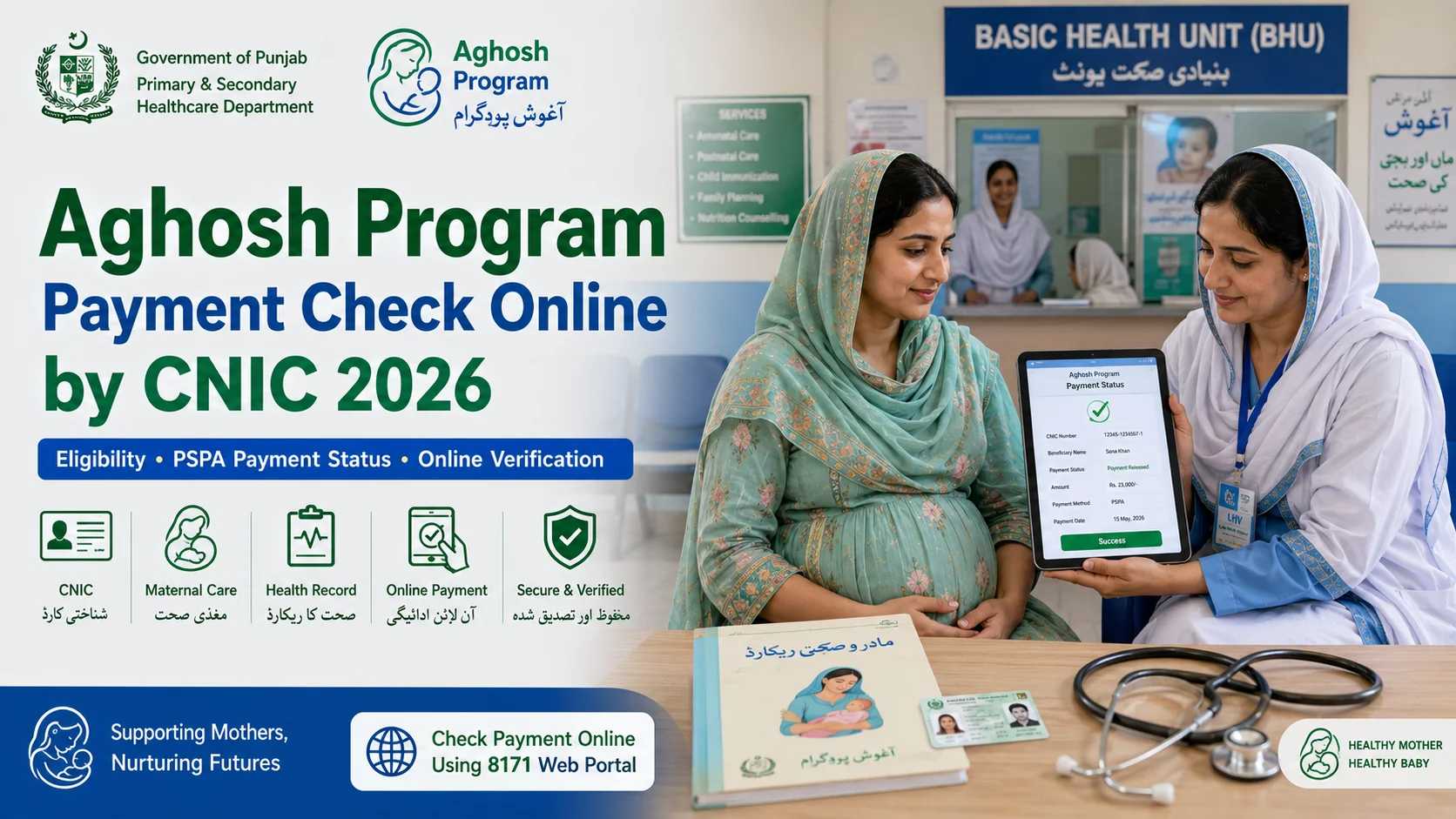
Meta Description: Learn how to complete Aghosh Program Payment Check Online by CNIC 2026, verify eligibility, check PSPA payment status, payment schedule, required documents, and registration process.
Aghosh Program Payment Check Online by CNIC 2026 – Complete Guide
The Aghosh Program is a maternal and child health initiative launched by the Punjab Government under the Punjab Social Protection Authority (PSPA) to support pregnant women, lactating mothers, and mothers of young children through financial assistance. The program encourages regular medical checkups, institutional deliveries, child immunization, and birth registration by providing payments at different stages.
If you want to complete an Aghosh Program Payment Check Online by CNIC, verify your eligibility, understand the payment schedule, or learn how the PSPA system works, this guide explains everything in simple English.
Quick Overview
| Program | Aghosh Program 2026 |
|---|---|
| Managed By | Punjab Social Protection Authority (PSPA) |
| Project | Punjab Human Capital Investment Project (PHCIP) |
| Target Beneficiaries | Pregnant & Lactating Women |
| Province | Punjab |
| Payment Verification | Online by CNIC |
| Registration | Government Health Facility |
| Payment Method | Milestone-Based Financial Assistance |
What is the Aghosh Program?
The Aghosh Program is a government welfare scheme that provides financial support to eligible women throughout pregnancy and the early stages of child development. Instead of offering a one-time payment, the program provides financial assistance after specific healthcare milestones are completed.
The main objective is to improve maternal health, encourage institutional healthcare, reduce pregnancy-related risks, and ensure that children receive timely vaccinations and medical care.
Objectives of the Aghosh Program
The Punjab Government introduced the Aghosh Program to:
- Improve maternal healthcare.
- Encourage regular antenatal checkups.
- Promote safe deliveries at government health facilities.
- Increase child immunization rates.
- Support low-income families with healthcare expenses.
- Improve child nutrition and early healthcare.
Who Can Apply?
The program mainly supports women living in selected districts of Punjab.
Eligible applicants generally include:
- Pregnant women
- Lactating mothers
- Mothers of children up to two years of age
- Women registered at government health facilities
- Low-income households meeting the program criteria
Applicants must complete the required health visits to remain eligible for milestone payments.
Eligibility Criteria
Applicants should generally meet the following conditions:
- Resident of an eligible district in Punjab.
- Valid CNIC.
- Registered at a government health facility.
- Pregnancy or child recorded in the health system.
- Completion of required medical checkups.
- Participation in maternal healthcare services.
Meeting these conditions helps determine eligibility but does not guarantee approval until verification is completed.
Districts Covered Under the Aghosh Program
The program currently operates in selected districts of Punjab, including:
- Bahawalpur
- Bahawalnagar
- Bhakkar
- Dera Ghazi Khan
- Kot Addu
- Khushab
- Layyah
- Lodhran
- Mianwali
- Muzaffargarh
- Rahim Yar Khan
- Rajanpur
- Taunsa
Applicants should confirm whether their district is included before beginning the registration process.
Required Documents
Before registration or payment verification, prepare the following documents.
| Document | Purpose |
|---|---|
| Valid CNIC | Identity Verification |
| Registered Mobile Number | Communication |
| Pregnancy or Child Health Record | Medical Verification |
| Birth Certificate (where applicable) | Child Registration |
| Government Health Facility Registration | Eligibility Verification |
How to Register for the Aghosh Program
Women who meet the eligibility criteria can register through their nearest government health facility.
Step 1 – Visit the Health Facility
Visit the nearest Basic Health Unit (BHU), Rural Health Centre (RHC), or Tehsil Headquarters (THQ) Hospital.
Step 2 – Submit Your Documents
Provide your CNIC and the required health records.
Step 3 – Complete Registration
Health staff will register your information in the official health system.
Step 4 – Attend Medical Checkups
Continue attending all required antenatal and postnatal visits according to the program schedule.
Step 5 – Receive Payment Updates
After completing each milestone, your payment becomes eligible for processing.
Aghosh Program Payment Check Online by CNIC
Applicants can check their payment status through the official PSPA online system.
Step 1
Visit the official PSPA Payment Portal.
Step 2
Enter your CNIC number.
Step 3
Provide your registered mobile number if requested.
Step 4
Submit the information.
Step 5
View your payment status, eligibility, or verification details.
The portal allows beneficiaries to check whether payments are Approved, Pending, or Under Verification.
Aghosh Program Payment Schedule
The Aghosh Program follows a milestone-based payment system instead of providing a single payment. Eligible beneficiaries receive financial assistance after completing specific maternal and child healthcare stages.
The payment schedule generally includes:
| Stage | Financial Assistance |
|---|---|
| Registration at Government Health Facility | Rs. 2,000 |
| Four Antenatal Checkups | Rs. 6,000 |
| Delivery at Government Health Facility | Rs. 4,000 |
| Newborn Health Checkup | Rs. 2,000 |
| Birth Registration | Rs. 5,000 |
| Child Immunization | Rs. 4,000 |
Payments are released after successful verification of each completed milestone.
How Payments Are Processed
Once an eligible beneficiary completes the required healthcare milestone, the health facility updates the information in the official system. After verification, the Punjab Social Protection Authority (PSPA) processes the payment.
Beneficiaries can check their payment status online using their CNIC to see whether the payment is Approved, Pending, or Credited.
Benefits of the Aghosh Program
The Aghosh Program provides both healthcare support and financial assistance to eligible mothers.
Some of the key benefits include:
- Financial support during pregnancy.
- Incentives for regular medical checkups.
- Assistance for safe delivery at government hospitals.
- Support for newborn healthcare.
- Encouragement for birth registration.
- Financial assistance for child immunization.
- Improved maternal and child health outcomes.
How to Check Payment Status Without the Internet
Women who do not have internet access can still verify their payment through alternative methods.
They can:
- Visit the nearest Basic Health Unit (BHU).
- Visit a Rural Health Centre (RHC).
- Visit the Tehsil Headquarters (THQ) Hospital where they registered.
- Contact their Lady Health Visitor (LHV) for assistance.
Health staff can verify the beneficiary’s payment and registration status using the official system.
Common Problems During Payment Verification
Some beneficiaries may face delays or verification issues.
Common problems include:
- Incorrect CNIC number.
- Mobile number not matching official records.
- Incomplete health checkups.
- Birth not registered.
- Child immunization not completed.
- Information not updated in the health system.
- Payment still under verification.
Most issues can be resolved by visiting the registered government health facility and updating the required information.
Important Guidelines
Before checking your Aghosh Program Payment Online, remember the following:
- Enter your CNIC correctly.
- Keep your registered mobile number active.
- Complete every required medical visit.
- Keep your health records updated.
- Follow the official vaccination schedule.
- Use only official PSPA channels for payment verification.
Beware of Fraud
Applicants should stay alert against fake websites and agents claiming to provide faster payments.
To stay safe:
- Never pay any registration fee.
- Use only official PSPA platforms.
- Do not share your CNIC or personal information with unknown people.
- Ignore fake SMS messages and social media links.
- Visit only government health facilities for registration and verification.
Frequently Asked Questions (FAQs)
Who can apply for the Aghosh Program?
Pregnant women, lactating mothers, and mothers of children up to two years of age living in eligible districts of Punjab may apply if they meet the program requirements.
How can I check my payment online?
You can visit the official PSPA Payment Portal, enter your CNIC, and view your payment status.
Is registration free?
Yes. Registration is completely free through designated government health facilities.
What documents are required?
Applicants generally need:
- Valid CNIC
- Registered mobile number
- Pregnancy or child health records
- Birth certificate (where applicable)
- Registration at a government health facility
Why is my payment showing as pending?
Your payment may remain pending if your healthcare milestones have not yet been verified or your information is still being updated in the official system.
Final Words
The Aghosh Program Payment Check Online by CNIC 2026 makes it easier for eligible mothers to track their payments without visiting government offices repeatedly. Through the official PSPA system, beneficiaries can verify their payment status, monitor completed healthcare milestones, and stay informed about upcoming financial assistance.
To receive payments without delays, complete all required medical checkups, keep your registration details accurate, and rely only on official government health facilities and PSPA platforms for updates.


