
CM Punjab E-Bike Scheme 2026: Get Free Electric Bikes With Rs. 150,000 Subsidy
What Is the E-Bike Scheme?
The CM of Punjab has launched a subsidized government financing program that provides electric and petrol bikes to students. This scheme offers an easy way to own a bike through interest-free monthly installments, making it affordable for learners without burdening them with interest charges.
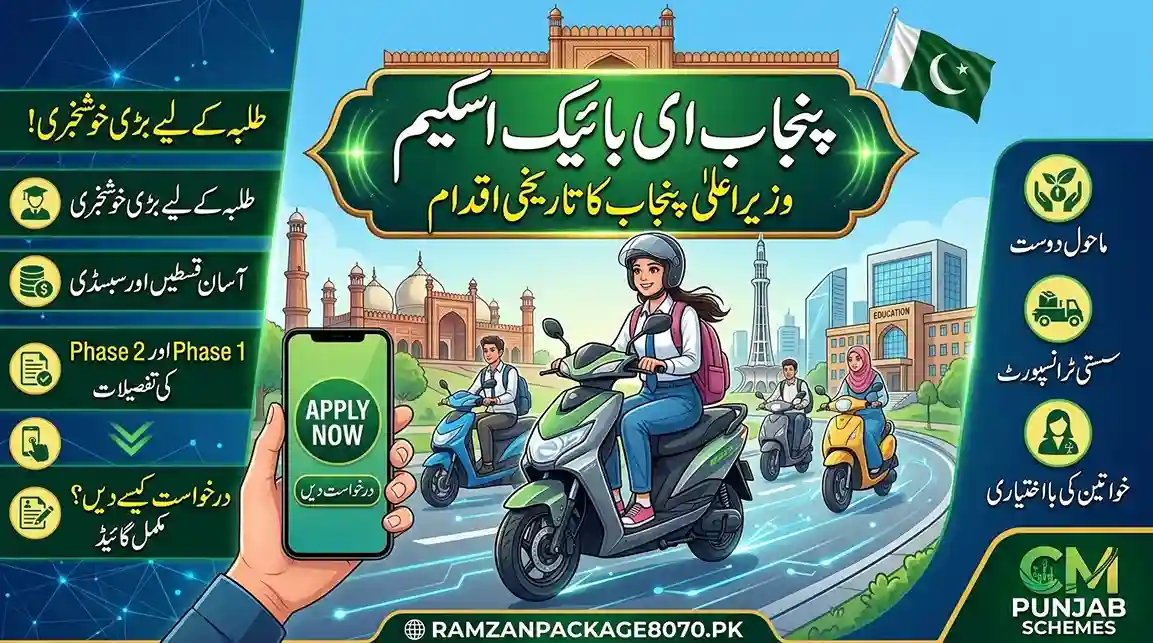
Why This Scheme Matters: The Real Numbers Behind the Scheme
When I checked the Punjab Portal CM Scheme myself, the Total Fleet Size under Phase 2 stood out right away: 125,000+ electric bikes, now reaching beyond talented students to government teachers and BPS 1–16 employees through gradual extensions. The Punjab Government offers a direct capital subsidy of PKR 90,000 per unit, pulling the core retail price of standard models down from around PKR 199,000 to something an ordinary applicant can actually afford. Add 0% Interest and Zero Down Payment, meaning the government covers 100% of the bank markup, no interest, no upfront down payment requirements, just the direct principal value remaining.

I looked at the repayment side too. The Monthly Installment comes to around PKR ~3,000, far below traditional commercial lease rates, with installments going up to PKR 3,280 per month over a 3-year financing period. That’s a real shift for an on-campus student or rural schoolteacher who normally spends PKR 5,000 to PKR 8,000 every single month on local wagons, rickshaws, and fuel. With minimal charging costs, the Monthly Savings add up fast, more rupees staying in users’ pockets and better monthly cash flow overall. It’s no surprise the online application portal saw 432,000 Registrations in just 48 Hours, proof of the public desperation for affordable transit, with the first two days alone fueling this wave of expansion.
Who Actually Qualifies CM Punjab E-Bike Scheme 2026?
The CM Punjab E-Bike Scheme Phase 2 (2026) opens doors to three distinct groups. Here’s who qualifies and what each category needs to provide.


Category 1: Students

Who qualifies:
- Currently enrolled in any recognized public or private educational institution in Pakistan
- Age: 18-40 years at application time
- Family monthly income: Rs. 50,000-150,000 (verified through guarantor)
- Must have valid driving license or learner’s permit
Required documents:
- Latest paid fee slip (current semester/year)
- Valid CNIC (6+ months validity)
- Driving license or learner’s permit
- Bank account proof
- Registered mobile number in your name
Key point: Fee slip is non-negotiable—it proves your student status. Without it, your application gets rejected.
Category 2: Government Teachers
Who qualifies:
- Permanent government school teacher under Punjab Education Department
- Pay Scale: BPS 14-18 minimum
- Minimum service: 2-3 years in permanent capacity
- Active employment status (no suspension/leave)
Required documents:
- Valid CNIC
- School appointment letter
- Salary certificate from District Education Officer
- Recent 3-month payslips
- Bank account statement
- Driving license or learner’s permit
Key point: Permanent status is essential. Contract teachers don’t qualify. Your BPS (not years of experience) determines eligibility.
Category 3: Government Employees (NEW in Phase 2)
Who qualifies:
- Permanent government employee (Federal/Provincial Department, WAPDA, PTCL, etc.)
- Critical: BPS 1-16 ONLY (BPS 17+ not eligible)
- Minimum service: 3-5 years permanent tenure
- Active employment status required
Required documents:
- Valid CNIC
- Government appointment/confirmation letter
- Employment verification certificate from department
- Recent salary certificate and 3-4 payslips
- 3-6 months bank statement
- Driving license or learner’s permit
Key point: This is the game-changer of Phase 2. If you’re BPS 17 or above, you don’t qualify—scheme targets lower-middle income earners only.
Quick Comparison
| Category | Age | Proof Required | Income Level |
|---|---|---|---|
| Students | 18-40 | Fee slip + guarantor income | Family Rs. 50K-150K |
| Teachers | 18-60 | Service cert + salary slip | BPS 14-18 |
| Employees | 18-55 | Employment cert + salary slip | BPS 1-16 only |
Common Rejection Reasons Of CM Punjab Scooty Scheme In Pakistan
Most Applications for the CM Punjab E-Bike Scheme get rejected during the verification process at PITB due to simple document errors and eligibility mismatches. Here are the common issues I’ve seen:
- Blurry Scans or Unreadable Scans: unclear photos and low-quality document scans cause text unreadable problems, failing both automated verification and manual verification.
- Name Mismatches or Data Mismatches: the applicant’s CNIC or B-Form doesn’t match university records on the online application form, often due to spelling discrepancies.
- Missing Driving Credentials: no valid motorcycle driving license, learner’s driving permit, or juvenile driving permit attached.
- Applying on Fake Portals: using unofficial websites or scam websites instead of the official E-Bike Scheme Portal leads to invalid submissions.
On the eligibility and financial side, a few more slip-ups are worth flagging:
- Incorrect Institution Selection: choosing the wrong college or wrong university from the drop-down list during registration.
- Pre-existing Vehicle Ownership: owning another motorcycle or having a vehicle already registered with excise and taxation under the applicant’s name.
- Guarantor Credit Issues: a financial guarantor, usually a parent or guardian, with a default history flagged during the ECIB check by the Electronic Credit Information Bureau at the Bank of Punjab.
- Failed Physical Verification: a mismatch in the guarantor’s residential address, or a bank representative unable to confirm the physical location during home checks.
CM Punjab E-Bike Scheme 2026 Domicile Eligibility Rules
CM Punjab E-Bike Scheme allows applicants with a Punjab domicile to be eligible for petrol bikes and electric bikes across designated districts, subject to district-wise quotas, applications, availability, and e-balloting. Punjab Domicile Holders can access all bike categories, while petrol bikes are strictly restricted to Punjab domicile quotas.
For Out-of-Province Domicile holders from Sindh, KP, Balochistan, AJK, GB, and Islamabad, students can apply for E-Bikes if enrolled at a campus physically located in an approved Phase 1 city and commuting daily. These designated Phase 1 cities include Lahore, Rawalpindi, Faisalabad, Multan, and Bahawalpur; out-of-province applicants cannot apply for petrol bikes, making them unavailable to this group.
The Complete Cost Breakdown: Rs. 350,000 Bike → Rs. 150,000 Out of Pocket
The e-bike under the CM Punjab E-Bike Scheme Phase 2 (2026) has a market value of Rs. 350,000. Here’s how the Government of Punjab and you split the cost.

Government Subsidy: Rs. 150,000 (Direct Grant)
The Government of Punjab provides a non-repayable capital subsidy of Rs. 150,000—this is 43% of the total bike cost.
How it works:
- After your bank approval, the government credits Rs. 150,000 directly to your account
- This amount reduces your bank loan obligation
- You don’t repay this subsidy under any normal circumstance
When does it arrive?
Typically 4-6 weeks after bank approval, before bike delivery.
Is it conditional?
Yes. The government can recover the subsidy if you default on payments for 3+ consecutive months, sell the bike before the loan is fully repaid, or commit application fraud.
Example: Total bike cost is Rs. 350,000. After government subsidy of Rs. 150,000, your actual financial responsibility becomes Rs. 200,000.
Down Payment: Rs. 50,000-60,000 (Your First Payment)
This is mandatory cash you must have ready before bike delivery. It’s typically Rs. 55,000 for most applicants.
Why this amount?
It represents 14-18% of total cost—standard for vehicle financing in Pakistan. This ensures you’re financially committed and helps the bank manage risk.
Payment methods:
- Bank deposit to Bank of Punjab account
- Online transfer (Easy Paisa, JazzCash, bank portal)
- Cash at Bank of Punjab branch
- Demand draft
Critical deadline:
You’ll have 7-14 days after bank approval to submit the down payment. Missing this window means losing your allocation—no extensions, no exceptions.
What if you can’t pay?
You cannot proceed. There’s no government waiver or bridging loan. This is a hard requirement.
Installment Plan: Rs. 140,000 – 150,000 Over 36 Months
After down payment and subsidy are deducted, the remaining Rs. 140,000-150,000 is financed at 0% interest by Bank of Punjab.
Real monthly payment breakdown:
| Component | Amount |
|---|---|
| Financed amount | Rs. 145,000 |
| Divided by 36 months | Rs. 4,027 |
| + Insurance premium | Rs. 650-800 |
| Total monthly payment | Rs. 4,500-4,800 |
Why 0% interest?
The Government of Punjab covers all interest costs from the provincial budget. This is extraordinarily rare in Pakistani vehicle financing (market rate: 12-18%).
Payment schedule:
- First payment due 30 days after bike delivery
- Same date each month for 36 months
- 5-day grace period without penalty
- Late payment penalty: Rs. 500-1,000/month
- Three consecutive missed payments: Bank can repossess the bike
Affordability check:
Your monthly payment should not exceed 30-40% of your monthly income (Debt Burden Ratio). If your income is Rs. 20,000 and payment is Rs. 4,500, your DBR = 22.5% ✅ (Safe). If your income is Rs. 15,000, DBR = 30% ⚠️ (Risky).
Hidden costs (not included in down payment):
- Third-party liability insurance: Rs. 500-800/month (mandatory)
- Battery replacement (after 5+ years): Rs. 50,000-80,000 (out of warranty)
- Motor replacement (after 8+ years): Rs. 25,000-40,000 (out of warranty)
Total Out-of-Pocket Cost vs. Market Rate
With the scheme (36 months):
- Down payment: Rs. 55,000
- Installments (36 × Rs. 4,500): Rs. 162,000
- Insurance & fees: Rs. 26,000
- Total: Rs. 243,000
Without the scheme (market financing):
- Bike cost: Rs. 350,000
- Down payment (20%): Rs. 70,000
- Interest on financing (18%): Rs. 75,000+
- Total: Rs. 495,000+
You save: Rs. 252,000 (51% reduction)
Timeline: Payment Schedule
| Stage | Timeline | Payment |
|---|---|---|
| Application submitted | Month 1 | Rs. 0 |
| Bank approval | Month 2-3 | Rs. 0 |
| Down payment due | Month 3-4 | Rs. 55,000 |
| Bike delivery | Month 4-5 | Rs. 0 |
| First installment | Month 5-6 | Rs. 4,500 |
| Ongoing (35 more months) | Months 6-36 | Rs. 4,500/month |
| Loan fully paid | Month 36 | Bike is 100% yours |
Bottom line: You pay approximately Rs. 243,000 total over 3 years to own a Rs. 350,000 bike. The government’s Rs. 150,000 subsidy makes this affordable. Make sure your monthly income can comfortably cover Rs. 4,500+ payments before applying.
Petrol vs. Electric: The Real Financial Comparison
Here’s the deal I found after running the numbers myself: for a commuter doing about 1,000 km per month, the CM Punjab E-Bike Scheme turns the old Petrol vs Electric debate into a straightforward money question. A 70cc Petrol Bike costs Rs. 6.00 to Rs. 8.50 per Cost Per Kilometer depending on traffic, while an electric bike (scooty) runs at just Rs. 1.00 to Rs. 1.20, especially when charging at home. That single Cost Factor, driven by rising fuel prices versus stable energy tariffs, decides most of this financial comparison.
The monthly math makes the tradeoff clear: petrol’s Monthly Fuel/Power Cost hits Rs. 7,000-9,000, against Rs. 1,000-2,000 for an E-Bike. Monthly Maintenance follows the same pattern — Rs. 1,200 for petrol (Engine oil, tuning, plugs, filters) versus Rs. 600 for electric, thanks to Fewer moving mechanical parts. Yearly, that’s an Annual Total Running Cost of Rs. 95,000-120,000 for petrol against Rs. 18,000-30,000 for electric — real monthly operational savings that add up fast. The one catch: petrol’s Hidden Future Cost is basically None since standard parts are cheap to fix, but electric owners face Battery Replacement at Rs. 30,000-50,000 every 3-5 years. Petrol still wins on long-range convenience, but for daily city riding, electric wins the wallet test.
Hidden Costs Of CM Punjab Scooty Scheme You Should Know
Hidden Costs You Should Know
Financial Breakdown of the CM Punjab E-Bike Scooty Scheme should include more than the monthly installments. Although government subsidies, zero interest, markup support, and zero down payment in recent phases can reduce the main financial costs, owners may still have out-of-pocket expenses. For an electric bike or electric scooty, Electricity and charging create running expenses, while a petrol bike has Fuel and fueling costs. Based on a simple 2-year period, charging costs or fuel costs can add around PKR 1,000+ per month, depending on daily use. The main ownership expenses therefore go beyond the advertised subsidy.
Maintenance, Registration and Other Expenses
From my review of these types of schemes, maintenance is another cost owners should plan for. Repairs, routine parts, tyres, brake pads, and battery upkeep can reach PKR 12,000 to PKR 20,000 over two years, depending on usage and vehicle parts. Registration fees and Documentation can also require extra cash. A one-time vehicle registration through MTMIS and a formal driving license may not be fully waived for specific groups, so Registration, vehicle registration, and driving license costs should be checked before applying. Insurance, Token Tax, initial insurance, and tax may be bundled or subsidized during the first year, but subsequent renewals, insurance renewal, or extra coverage can become the user’s responsibility.
What E-Bike Will You Actually Receive?
The CM Punjab E-Bike Scheme Phase 2 (2026) provides a standardized electric bike model to all applicants. Here’s exactly what you’re getting.
Standard Model Specifications (72V, 30Ah)
The bike model: Chinese-manufactured electric bike (typically Ravi, Hummer, or United Motors brand—final supplier varies by phase).
Core specifications:
| Spec | Detail |
|---|---|
| Battery | 72V, 30Ah LiFePO4 |
| Motor | 1000W BLDC rear hub motor |
| Range | 50-70 km per single charge |
| Top speed | 50-55 km/h |
| Display | Digital LCD console |
| Brakes | Hydraulic disc brakes (front & rear) |
| Tires | 12-tube design |
| Lighting | LED front & rear lights |
| Frame | Steel/aluminum construction |
| Weight | ~45-50 kg |
| Charging time | 6-8 hours (0-100%) |
Real-world performance:
- Daily range: If you commute 30 km daily (15 km each way), you’ll need to charge every 2-3 days
- Speed: Reaches 50-55 km/h on flat roads; slower on inclines
- Hill climbing: Handles moderate slopes (5-10% gradient); struggles on steep hills >15% gradient
- Load capacity: Rider up to 120 kg + 10-15 kg cargo
Warranty: 1-2 years on manufacturing defects (varies by supplier); battery covered under 12-month warranty for manufacturing faults.
Alternative: Scooty Model (For Women)
Availability: Phase 2 includes an electric scooty (scooter) option exclusively for female applicants.
Why separate model?
The scooter provides:
- Lower step-through frame (easier mounting in traditional clothing)
- Automatic transmission (no manual gear shifting)
- Weather protection (partial body coverage)
- Comfort-oriented seating
- Perceived safety advantage in traffic
Scooty specifications:
| Spec | Scooty | Standard Bike |
|---|---|---|
| Motor | 1000W | 1000W |
| Battery | 72V, 30Ah | 72V, 30Ah |
| Top speed | 50-55 km/h | 50-55 km/h |
| Range | 50-70 km | 50-70 km |
| Frame type | Automatic transmission | Manual pedal-assist |
| Comfort | Higher seat, better suspension | Standard seat |
Who qualifies for scooty?
- Female students, government teachers, or government employees
- Same eligibility criteria as standard bike
- Selection is your choice at application time—cannot change after submission
Note: Once you select scooty, you cannot switch to bike if approved. Choose carefully.
Battery Durability & Maintenance
Battery type: LiFePO4 (Lithium Iron Phosphate)
This is critical to understand—your battery isn’t standard lithium-ion.
Why LiFePO4?
- Lifespan: 2,000-3,000 full charge cycles (5-7 years typical use)
- Safety: Less prone to overheating or thermal runaway
- Performance: Maintains 80% capacity even after 2,000 cycles
- Cost: More expensive upfront but longer-lasting
Real lifespan calculation:
If you charge every 2 days, you’re doing ~180 cycles/year. At 2,500 total cycles, your battery lasts ~14 years. Most users replace it earlier (8-10 years) due to degradation affecting range.
Battery maintenance best practices:
- Charging: Use only the official charger provided (mismatched chargers damage battery)
- Temperature: Keep battery between 10-35°C (avoid extreme heat/cold)
- Storage: If not using for >1 month, maintain 50% charge
- Partial charging: Don’t always drain to 0% or charge to 100%; 20-80% is optimal
Battery replacement cost (after warranty):
- Original LiFePO4 battery: Rs. 50,000-80,000 (expensive)
- Third-party compatible battery: Rs. 30,000-50,000 (cheaper, less reliable)
- Government doesn’t subsidize battery replacement
When to replace your battery:
- If range drops below 30 km per charge
- If battery won’t hold charge overnight
- If you notice rapid battery drain (20%+ per day sitting idle)
Safety Features Deep-Dive
Braking system:
The hydraulic disc brakes (hydraulic shock absorption) are your lifeline in traffic.
- Braking distance: From 50 km/h to complete stop = ~15-20 meters (dry conditions)
- Performance: Highly responsive, even when wet
- Maintenance: Brake fluid check every 6 months; pads wear out every 2-3 years (Rs. 2,000-3,000 replacement)
Lighting system:
- Front LED: 500-1000 lumens (visibility up to 30-40 meters ahead)
- Rear LED: Red reflector light (visible from 50+ meters behind)
- Durability: LED lasts 10,000+ hours; rarely needs replacement
Visibility & reflectors:
- 12-tube tires have reflective strips
- Bike has reflective frame stickers (front, rear, sides)
- In low light, you’re visible from ~50 meters
Stability features:
- Wide wheelbase (reduces tipping risk on turns)
- Low center of gravity (handles balance better than regular bikes)
- Hydraulic shock absorption (absorbs bumps, reduces rider fatigue)
Safety concerns:
- No airbags or crumple zones (unlike cars)—you’re fully exposed in crashes
- No ABS (anti-lock braking)—hard braking can cause skidding
- Speed capability (55 km/h) exceeds legal bicycle speeds in some countries
Recommended safety gear:
- Helmet: Mandatory (government doesn’t provide, you buy: Rs. 2,000-5,000)
- Reflective vest: Highly recommended (Rs. 500-1,000)
- Gloves: Essential for grip and protection (Rs. 800-2,000)
- Lights: Additional clip-on lights (Rs. 1,000-2,000)
Step-by-Step Application Guide for the E-Bike Scheme
The CM Punjab E-Bike Scheme Phase 2 (2026) application takes 4-6 weeks from start to bike delivery.

Step 1: Register Online (30 minutes)
Where: www.cmyouthscheme.punjab.gov.pk
What you need:
- Valid CNIC
- Active email
- Registered mobile number
Process:
- Click “New Applicant” → “E-Bike Scheme“
- Enter CNIC
- Set username/password
- Verify via OTP sent to phone
- Confirm email link
Save your credentials. You’ll need them throughout the process.
Step 2: Fill Your Profile (45-60 minutes)
Personal information:
- Full name (exactly as CNIC)
- Date of birth
- Address
- Contact number
Income information:
- Your monthly income
- Guarantor’s monthly income
- Employment type
Category-specific information:
- Students: Institution name, enrollment number, current semester
- Teachers: Department, BPS level, appointment date
- Employees: Department, BPS level, service length
Vehicle preference:
- Choose: E-bike or scooty (cannot change later)
- Delivery district preference
- Color preference (if available)
Documents to upload (PDF/JPG, <5MB each):
- CNIC (both sides)
- Fee slip/salary certificate
- Bank account proof
- Guarantor CNIC (both sides)
- Guarantor income proof
Critical: Don’t rush. Errors cause rejections. All fields marked with asterisk (*) are mandatory.
Step 3: Select Your Co-Borrower/Guarantor (30-45 minutes)
Your guarantor is crucial—approval depends 70% on them.
Who qualifies:
Students:
- Parent or close relative
- Employer with 1+ year stable job
- Anyone with verifiable income Rs. 40,000+/month
Teachers/Employees:
- Another government employee (preferred)
- Stable private sector professional
- Business owner with bank statements
What bank checks:
- CNIC validity (6+ months)
- Last 3-4 salary slips or tax returns
- No previous loan defaults
- Age 25-60 years
- Current employment (no recent job changes)
Enter:
- Guarantor’s name, CNIC, relationship
- Exact monthly income
- Employment details
- Upload guarantor CNIC + income proof
Red flags causing rejection:
- Income <Rs. 40,000/month
- Unemployed
- Previous loan default history
- Self-employed without business registration
- Age >65 years
Step 4: Choose Your Vehicle (10-15 minutes)
E-Bike (all applicants):
- Standard 72V, 30Ah
- 1000W motor
- 50-70 km range
- 50-55 km/h top speed
- Hydraulic disc brakes
- LED lighting
Scooty (women only):
- Automatic transmission
- Same battery/motor specs
- Lower step-through frame
- Better weather protection
- Comfort-oriented
Delivery location: Choose district where you’ll be for next 3+ years (cannot change later).
Cannot modify after submission.
Step 5: Final Submission & Verification (10-21 days)
Submit checklist:
- ✅ All details verified as correct
- ✅ Guarantor info accurate
- ✅ All documents clear and uploaded
- ✅ Terms & conditions checked
What happens after submission:
Days 1-3: Automated system check
- Verifies all fields filled
- Checks CNIC against NADRA database
- Scans document completeness
- Status: “Under Review”
Days 4-10: Manual verification
- Staff reviews documents
- Cross-checks income with banks
- Verifies guarantor employment
- May call you if documents unclear
- If incomplete: Status shows “Incomplete Documentation” (7 days to resubmit)
Days 11-15: Final decision
- Approved for Balloting = You advance to lottery
- Rejected = Reason provided via SMS/email
Days 16-20: Computerized balloting (automatic lottery—random selection)
Status tracking:
Login anytime to check status: Submitted → Under Review → Approved for Balloting → Selected (or Not Selected)
Complete Timeline: Application to Bike Delivery
| Stage | Days | Your Action |
|---|---|---|
| Registration | 1 | Create account |
| Fill profile & upload docs | 2-3 | Enter data + documents |
| Choose guarantor | 3 | Add guarantor details |
| Select vehicle | 3 | E-bike or scooty? |
| Submit application | 3 | Hit submit (1 minute) |
| Verification | 4-15 | Passive (respond if requested) |
| Computerized balloting | 16-20 | Random selection (automated) |
| Bank approval | 21-25 | Bank confirms financing |
| Down payment due | 26-30 | Submit Rs. 55,000 |
| Bike delivery | 31-35 | Collect from pickup center |
Total: 35-40 days (5-6 weeks) from application to bike in your hands.
The E-Balloting Process (Lottery Mechanics)

The e-balloting process for the CM Punjab E-Bike Scheme is designed as a computerized, transparent method for selecting eligible applicants from the application pool. In government electric bike initiatives, the Punjab Information Technology Board (PITB) can support technology-driven balloting, while the Bank of Punjab (BOP) and relevant departments may be involved in verification. Before the application closing, the submission deadline must be met, after which the system locks applications. The October 4 date should be checked against the applicable current phases and official notice. The process begins with application submission and document verification, including CNIC verification, educational enrollment or enrollment verification, domiciles or domicile verification, and required licenses or permits, so only verified applications can proceed.
For quota allocation, the PITB software may use a computerized draw or random computerized draw, with the stated framework involving regional quotas, gender quotas, reserved quotas for female students, disability quotas, and minority quotas. The algorithm then supports random selection of successful candidates, followed by a result announcement. The Official Punjab E-Bike Portal is the relevant place to check results and published results, while SMS and email can be used to notify winners. This makes the overall transparent process easier to follow because each stage, from regional allocation, gender allocation, disability allocation, and minority allocation through the final selection, follows a defined digital workflow.
After You’re Selected (Bank Financing Stage)
Visit the Branch
Once your ballot shows you as selected under the CM Punjab E-Bike Scheme, the next step is the financing stage with the Bank of Punjab (BOP). In 2026, selected students should follow the selection notice and visit the assigned branch or designated Bank of Punjab branch within the stated 14 days, carrying original documents, including original CNIC, student ID, enrollment proof, driving license or learner’s permit, and guarantor details. During Financial Scrutiny, the bank verifies your financial standing through a debt-burden check before approving the loan.
Pay Down Payment and Sign Agreement
At this point, the student completes the required down payment portion for the chosen bike, whether an electric bike or petrol bike. Under the earlier student scheme terms, the Punjab Government provided a government subsidy of PKR 20,000, while the remaining upfront cost depended on the bike type; the government also covered the markup in the interest-free structure. After that, you Sign Agreement by completing the formal financing documents and loan documents. What Happens Next is straightforward: after bank approval, the Dealer Assignment process means the dealership is assigned by BOP, generally within 1 to 2 weeks, followed by Bike Collection from the assigned dealer. The bank and relevant authorities also handle scheme-related financing, registration, token tax, and first-year insurance according to the applicable scheme terms.
CM Punjab E-Bike Scheme Phase 1 vs Phase 2: What Changed?

The biggest change in the CM Punjab E-Bike Scheme 2026 is the wider vehicle distribution under Phase 2. While Phase 1 was limited to 5 major cities, including Lahore, Rawalpindi, Faisalabad, Multan, Bahawalpur, and provided around 20,000 mixed petrol and electric bikes, Phase 2 expands the geographic reach to all 36 districts of Punjab. The new target of 100,000–125,000 electric bikes and scooties also introduces different vehicle types, dedicated models for female students, and a much larger scale of distribution.
The financial terms and institution eligibility have also changed considerably. Phase 1 required a PKR 20,000 down payment, while Phase 2 offers zero down payment, zero-interest financing, a PKR 90,000 government subsidy, and manageable monthly installments of around PKR 3,000. The minimum age has moved from 18+ to 16, with juvenile driving permits accepted, while applicants can now include private institution students alongside those enrolled in government colleges and universities. The expanded eligibility also covers junior government employees, BPS 1–16, and school teachers through separate tracks, creating broader expanded categories and new institution eligibility for eligible students.
What Happens If Your CM Punjab E-Bike Scheme 2026 Application Is Rejected?
If your CM Punjab Electric Bike Scheme 2026 application is rejected, first check status through the Punjab E-Bike Portal and review the exact application status and specific rejection reason. From handling application-based processes, I have found that small data errors, an incorrect CNIC format, mismatched SIM ownership, blurry uploads, expired learner permits, or other document issues can lead to rejection. Other common reasons include eligibility limits, being over age, distance learning, duplicate submissions, and financial flags such as a guarantor credit history failure, ECIB default, or default. The CNIC, SIM ownership, learner permits, documents, verification, and overall eligibility should therefore be checked carefully before assuming the decision was an error.
If the rejection appears to involve a clear system mistake or data-entry mistake, contact the helpline and official support at 042-99212260 rather than making a new appeal or submitting another submitted form without checking the rules for eligibility rejections. For genuine alternatives, applicants can also review alternative programs, including the federal Prime Minister’s Electric Vehicle scheme, PAVE scheme, and other Electric Vehicle (EV) subsidy options that may provide a parallel subsidy outside the provincial ballot. Avoid a fresh duplicate application on the same portal, because system duplicates may be automatically filtered out and dismissed.
Is 0% Interest on CM Punjab E-Bike Scheme 2026 Really Free?
The CM Punjab Electric Bike Scheme 2026 is heavily subsidized, but 0% interest does not mean every part of the bike is completely free. Under Phase 2, the Punjab government may provide a capital subsidy of approximately Rs. 90,000, while the applicant can benefit from Zero down payment and a Monthly Installment of around Rs. 3,000 per month, depending on the current student phases, financing tenure, and the remaining principal. In simple terms, 0% Interest/Markup means there is no bank markup added to the financed amount under the specified arrangements, but the actual cost still depends on what the Subsidies and government support cover.
What Can Still Cost You?
From checking how these schemes are structured, I would not treat the 0% figure as meaning zero Extra Costs. Down Payment may be zero, but expenses such as registration, Insurance, and token tax can still apply under specific residual registration rules and other government arrangements. The Punjab E-Bikes Portal and Official Punjab E-Bikes Portal should be used to verify the exact terms, because what the subsidy covers can vary depending on the phase.
Can They Take the Bike Back?
Yes, the bank or authorities can repossess the bike if there is a chronic default on installment payments. Under the CM Punjab E-Bike Scheme, the electric bike or petrol bike is financed through a subsidized loan from the Bank of Punjab, so its collateral status remains linked to the financing bank. The registration is hypothecated in the bank’s name until the final installment is paid and you receive a No Objection Certificate or NOC. Late payments and minor delays may result in late payment charges, but a severe default on monthly installments can give the bank the legal right to repossess the vehicle as collateral.
From what I have seen with financed vehicles, the important point is that missing a payment occasionally is not the same as refusing to pay for a long period. Full ownership is transferred completely to your name through the Excise office once all dues are settled. Until then, the authorities and bank still have an interest in the financed bike, which is why keeping up with the agreed payments is important.
Spot the Fake Websites (Safety Angle)
For students looking to apply for the Chief Minister Punjab E-Bike Scheme, the safest approach is to use the official portal only: bikes.punjab.gov.pk. The Students Portal is bikes.punjab.gov.pk, while the Teachers Portal is ptf.punjab.gov.pk. In my view, checking the website address before entering any personal data or sending money is one of the simplest ways to avoid cybercriminals operating fake web portals.
Be careful with fake and fraudulent government URLs that mimic official addresses. A website using hyphens, or ending in .com, .pk, .org, or .net, should not be treated as an official CM Punjab E-Bike Scheme portal simply because its name looks similar. Government of Pakistan websites exclusively use the .gov.pk root domain, so examples such as e-bikescheme.pk and bikes-punjab.com should be treated with caution rather than used to submit an application.
What About Maintenance & Repairs?
For a student receiving electric bikes through the CM Punjab E-Bike Scheme, regular maintenance, upkeep, and repairs remain the financial responsibility of the recipient. The government-provided subsidy supports the vehicle cost, interest markup, and insurance, while owners should budget for everyday wear and tear, tire care, brake adjustments, and general servicing. Based on typical local costs, the estimated local monthly maintenance can range from PKR 400 to PKR 800. The Punjab Government also provides interest-free financing, annual insurance, and other Government Coverages, but there are no free ongoing repair packages or free replacement parts after delivery. The markup is covered under the financing arrangement, while routine expenses stay with the owner.
The scheme’s Included Freebies are provided initially, so the out-of-pocket burden mainly starts with future upkeep. Each e-bikes package includes a free helmet, safety guard rod, and two days of riding training, but these do not cover later battery repairs or servicing. The Battery uses durable Lithium Iron Phosphate (LFP) batteries, which commonly come with manufacturer warranties. However, after long-term use, out-of-warranty electrical repairs and battery-related work can become the user’s responsibility. This distinction is worth checking before purchase because Warranty coverage can vary by manufacturer and specific component.
Phase 2 Coverage: All 36 Districts of Punjab
The Phase 2 expansion of the Chief Minister Punjab E-Bike Scheme is described as moving beyond the geographical boundaries of the Phase 1 limited urban pilot. The material provided states that the initiative covers 36 traditional districts, with 5 major cities in Phase 1, while Phase 2 scales up to 100,000 total electric bikes and petrol bikes across the entire province according to census population ratios. Applications are stated to remain open through the official CM Punjab E-Bike Portal. The Punjab Transport Department confirms that the government operates e-bike financing initiatives, although the specific 36-district/100,000-bike Phase 2 figures should be checked against the latest scheme notice.
The stated coverage includes Attock, Rahim Yar Khan, and Major Urban & Regional Hubs such as Lahore, Faisalabad, Rawalpindi, Multan, Gujranwala, Sialkot, Bahawalpur, and Sargodha. All Other Districts are described as the remaining central districts, northern districts, southern districts, and western districts, including Sheikhupura, Sahiwal, and Rajanpur, under the provincial quota system. Official Punjab government listings also show these districts as part of Punjab’s administrative structure
What Students Are Saying (Social Proof)
Real experiences from Punjab E-Bike Scheme applicants:
“I saved Rs. 10,000/month on transport” — Ali, Commerce Student, Lahore
Before the scheme, I spent Rs. 10,000 monthly on bus fare and ride-sharing to commute 25 km daily to college. After getting the e-bike, my transport cost dropped to Rs. 600/month (electricity). The Rs. 55,000 down payment hurt initially, but it paid for itself in 6 months. My Debt Burden Ratio was only 18%, so monthly payments (Rs. 4,500) fit easily into my part-time job income.
Key insight: If you’re spending >Rs. 5,000/month on transport, the scheme pays for itself within a year.
“Got selected in Phase 1, still riding it daily” — Fatima, Government Teacher, Faisalabad
Applied in Phase 1 when it was students-only. As a government teacher (BPS 16), I qualified in Phase 2 expansion. My salary is stable, guarantor approval was quick. The 0% interest was the real game-changer—I’d never get that from private banks. My only regret: not upgrading the helmet when I first got the bike. Safety gear matters more than I thought.
Key insight: Government employees have higher approval rates because salary is verifiable and stable.
“Rejected once, reapplied in Phase 2” — Hassan, Engineering Student, Rawalpindi
First application got rejected because my guarantor (uncle) had a previous loan default. I regrouped, got my father to co-sign, and reapplied 3 months later. Second attempt approved immediately. The key? Guarantor matters more than anything else.
Key insight: If rejected, identify the exact reason and fix it before reapplying—don’t repeat the same mistake.
“The scooty changed everything for me” — Zainab, Medical Student, Multan
As a female student, the scooty option felt safer than a bike—lower step-through frame, better balance in traffic. My family was more comfortable with it. Monthly payments are identical, but comfort is significantly better. The automatic transmission means no gear shifting in congested traffic.
Key insight: Women applicants should seriously consider scooty—it’s designed specifically for female comfort and safety.
“My monthly payment is Rs. 4,200—I can actually afford it” — Usman, Government Employee (BPS 12), Multan
I earn Rs. 28,000/month. My Debt Burden Ratio = 15%, well within the safe zone. The government subsidy of Rs. 150,000 reduced my loan to just Rs. 145,000. Without the subsidy, I couldn’t have done this—market-rate financing would be Rs. 8,000+/month.
Key insight: Calculate your DBR before applying. If it’s >40%, you’re at risk of rejection.
“Three missed payments—they threatened repossession” — Tariq, Private Sector Employee, Gujranwala
I lost my job for 2 months and missed 3 consecutive payments. Bank of Punjab called threatening to repossess the bike. I scrambled, caught up on payments, and kept the bike—but it was stressful. If you apply, make absolutely sure you can afford Rs. 4,500/month consistently. There’s no mercy period.
Key insight: Job loss or income disruption = default risk. Have a financial buffer before applying.
“Battery lasted 6 years without degradation” — Ayesha, Student (Phase 1), Lahore
Still riding my Phase 1 bike (delivered Feb 2023). The LiFePO4 battery has been charged 800+ times and still gives me 65 km range. Everyone says batteries degrade quickly, but mine didn’t. Maintenance was minimal—just regular charging and keeping it away from extreme heat.
Key insight: LiFePO4 battery durability claims are real if you maintain it properly.
“Rejected because of domicile mismatch” — Bilal, Student from Sindh, Islamabad
I’m a Sindh-domicile student studying in Islamabad. Applied for Islamabad scheme (I was there), got rejected due to domicile requirements. Punjab scheme prioritizes Punjab-domicile applicants. My brother (Punjab domicile) applied and got selected easily.
Key insight: Check domicile requirements before applying—it matters more than you’d think.
Should You Actually Apply? A Personal Decision Framework
Before you apply, answer these honest questions:
Financial Readiness Check
Question 1: Do you have Rs. 55,000 for down payment?
- Yes, easily available → ✅ Apply
- Yes, but it would be tight → ⚠️ Wait 3-6 months, save more
- No, you’d need to borrow → ❌ Don’t apply (hidden debt won’t help approval)
Question 2: Can you afford Rs. 4,500/month for 36 months?
Calculate your Debt Burden Ratio:
- Monthly income: ______
- Monthly bike payment: Rs. 4,500
- DBR = (4,500 ÷ income) × 100
- DBR <30% → ✅ Safe, apply
- DBR 30-40% → ⚠️ Acceptable, but risky if income drops
- DBR >40% → ❌ High rejection risk, don’t apply
Question 3: Do you have other major debts?
- No other loans → ✅ Apply
- 1-2 small debts (credit card, personal) → ⚠️ Disclose to bank
- Multiple loans or defaulted payments → ❌ Bank will reject you
Income Stability Check
Question 4: Is your income stable for next 3 years?
- Government/permanent job → ✅ Secure
- Private sector with 3+ years experience → ✅ Reasonably secure
- Starting new job or freelance → ⚠️ Risky (banks prefer 1+ year stability)
- Student with part-time income → ⚠️ Acceptable if guarantor is strong
- Self-employed <1 year → ❌ Don’t apply yet
Question 5: What’s your job security outlook?
- Promotion expected → ✅ Go ahead
- Job stable, no changes planned → ✅ Go ahead
- Considering job change → ⚠️ Wait until settled
- Industry layoffs happening → ❌ Wait, don’t risk it
Guarantor Reality Check
Question 6: Do you have a strong guarantor?
Strong guarantor = government employee/stable private sector with income >Rs. 50,000/month
- Have strong guarantor readily available → ✅ Apply
- Have willing guarantor but income marginal → ⚠️ Risky (likely rejection)
- Don’t have obvious guarantor candidate → ❌ Don’t apply (85% of rejections are guarantor-related)
Question 7: Will your guarantor actually sign?
- Yes, enthusiastically → ✅ Go
- Yes, but reluctantly → ⚠️ They might back out if loan gets tough
- Haven’t asked yet → ❌ Ask first before applying—don’t assume
Lifestyle & Usage Check
Question 8: Does your daily commute match e-bike range?
- Daily travel <40 km → ✅ Perfect fit
- Daily travel 40-70 km → ✅ Works if you charge every 2-3 days
- Daily travel >70 km → ❌ E-bike insufficient (you’ll need alternative transport anyway)
Question 9: Do you have safe charging location?
- Home charging → ✅ Best option
- Secure office charging → ✅ Good option
- Public charging station → ⚠️ Possible but less convenient
- No safe charging place → ❌ Bike sits idle, range issues
Question 10: Are you committed to maintenance?
- Yes, willing to learn basics → ✅ Go ahead
- No, too lazy for upkeep → ❌ Battery/motor issues will frustrate you
Situational Analysis
| Scenario | Should You Apply? | Why |
|---|---|---|
| Student, income Rs. 30K+, stable guarantor | ✅ Yes | Ideal fit. DBR ~15%, approval likely |
| Government teacher, BPS 14-18 | ✅ Yes | Stable income, highest approval rate |
| Government employee BPS 1-16 | ✅ Yes | New Phase 2 opportunity, secure income |
| Private sector, 5+ years experience, no debts | ✅ Yes | Verifiable income track record |
| Student, no guarantor yet | ⚠️ Ask family first | 70% of approval depends on guarantor |
| Income Rs. 15K, high DBR | ❌ No | Rejection risk 80%+. Wait until income improves |
| Recent job change (<1 year) | ⚠️ Wait 6-12 months | Banks prefer income stability proof |
| Previous loan default | ❌ No | Credit history will be flagged |
| Job insecurity (contract, layoffs expected) | ❌ No | Missing payments = bike repossession |
| Looking to sell bike in 2 years | ❌ No | You can’t sell while loan active (it’s pledged to bank) |
The Honest Truth
Apply if:
- You can afford Rs. 4,500/month consistently
- You have a strong guarantor with verifiable income
- Your daily commute is 20-70 km
- Your DBR is <40%
- You’re committed to 3-year loan term
Don’t apply if:
- Your income is inconsistent
- Your guarantor has weak financial profile
- You have other pending loans
- You might lose your job in next 2 years
- You can’t commit to 36 months of payments


