
Benazir Taleemi Wazaif Check Online by CNIC
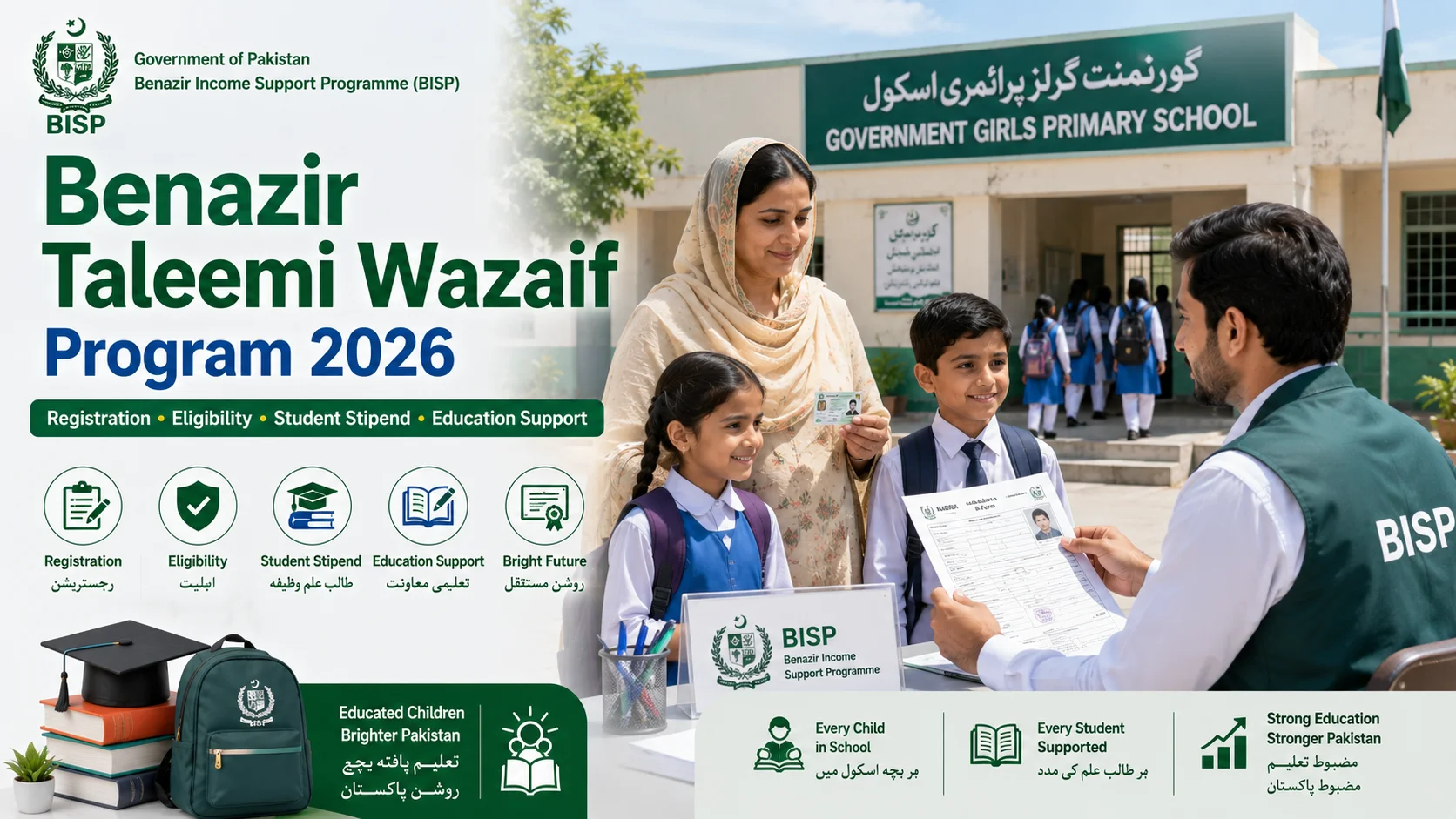
The Benazir Taleemi Wazaif stands as one of Pakistan’s largest educational support initiatives under the Benazir Income Support Programme — a Conditional Cash Transfer Programme designed to bring education within reach for children of BISP active Kafalat beneficiaries up to the higher secondary level. Having personally followed this programme since its early days, I can say that the way it uses additional cash incentives to keep children enrolled in schools and colleges while working to discourage dropout rate is genuinely thoughtful policy-making. It isn’t just about handing over money — it’s about creating retention in classrooms where it matters most.

In May 2026, thousands of families are checking their stipend payments online through the 8171 CNIC verification system, and the demand for this financial assistance has never been higher. The programme was built for women already registered in the Benazir Kafalat Program, allowing parents to verify eligibility, payment details, and registration information right from home using just a CNIC number — no middlemen, no hassle.

What makes this unique is that unlike unconditional cash transfer programs, this one operates under a structured umbrella that releases stipends every three months to students from class 1 through 12 — covering FSc, FA, and ICS levels. The mother must be a beneficiary of the Benazir Kafaalat program, and the system deliberately shows a degree of gender prioritization — favoring girls with a higher stipend because the literacy ratio of boys already surpasses that of females. This bias in stipend distribution is intentional, aimed to promote gender equality. Students are also encouraged to explore the PM Laptop Scheme alongside this support. The journey began in 2012 with just 5 districts, scaled to 27 more by 2015 hitting 32 districts total, was renamed Ehsaas Taleemi Wazaif under the Ehsaas Program Umbrella in 2019, expanded to all districts across Pakistan in 2020, and was finally renamed back by the Government to Benazir Taleemi Wazaif Program in 2022.

The Benazir Taleemi Wazaif Programme was piloted in just five (5) districts back in November 2012 — a humble beginning that few predicted would grow into a nationwide movement. Gradually, the reach expanded to thirty-two (32) districts by 2015, then pushed further to fifty (50) districts in 2018. By January 2020, it had stretched to hundred (100) districts, and finally in July 2020, the programme achieved full coverage across all districts of Pakistan — a milestone worth acknowledging.

OBJECTIVES

The core objectives of Benazir Taleemi Wazaif were never just bureaucratic checkboxes — they were built around a genuine understanding of what low-income households in Pakistan face daily. The programme aims to create long term sustainable awareness about the importance of primary, secondary, and higher secondary education among BISP beneficiary families, while simultaneously working to increase enrolment of children in schools, improve school attendance, and decrease school dropout rates across the board.

The government recognized that when poor families struggle to survive, educational expenses for children fall off the priority list entirely. That’s why BISP introduced this programme — to enhance attendance across primary, secondary, and higher secondary education in schools and colleges, help parents cover the real costs of keeping kids in classrooms, decrease dropout rates, and crucially, to raise the literacy rate among girl children of poor families and genuinely support girls’ education at every level.

  • Child must belong to an active BISP Kafalat beneficiary household
  • Mother must be an active Benazir Kafaalat Program beneficiary
  • Mother must have a valid CNIC
  • Child must have a valid NADRA B-Form
  • Child must be enrolled in a school or college
  • Student attendance must remain above 70%
  • Family must have an updated BISP Dynamic Survey
  • School admission must be officially confirmed
  • Student must obtain the Principal’s or Headmaster’s signature on the Benazir Taleemi Wazaif Slip
  • Missing the school signature may delay enrollment or payments

Age & Class Criteria

  • Primary Education: Age 4–12 years | Class 1–5
  • Secondary Education: Age 8–18 years | Class 6–10
  • Higher Secondary Education: Age 13–22 years | Class 11–12

Method 1: Check Online via 8171 Web Portal

What you need:

  • Mother’s 13-digit CNIC number
  • Active internet connection

Steps:

  • Visit the BISP 8171 Web Portal (official site)
  • Enter your 13-digit CNIC number (without dashes)
  • Fill in the 4-digit captcha verification code
  • Click the Submit button
  • Your May 2026 payment status and eligibility details appear instantly

What the portal shows:

  • Payment confirmation status
  • Eligibility verification
  • Child registration details
  • Survey status
  • Pending verification updates

Method 2: Visit Your Nearest BISP Tehsil Office

Best for: Those without internet access

  • Go to your nearest BISP Tehsil Office in person
  • Carry your CNIC with you
  • Share your CNIC with the staff at the counter
  • Staff will instantly pull up your eligibility status
  • Payment installment details for all registered children will be provided on the spot

Quick Comparison

  • 8171 Web Portal — Requires CNIC + internet, gives instant online results
  • BISP Tehsil Office — Requires CNIC only, provides in-person verification

The SMS method is a lifeline for families who don’t have internet — open your mobile message app, type your CNIC number, send it to 8171, and within moments you’ll receive eligibility status, payment information, and verification details directly on your phone. No smartphone needed, no data required.

If your internet connection is down or you’re on a keypad mobile phone, the BISP 8171 SMS Service handles eligibility and stipend checks for children just as effectively. You’ll need the mother’s CNIC — she must be a beneficiary in the BISP Benazir Kafaalat Program — to pull up status for children. Open your mobile messaging app (not WhatsApp), enter the 13-digit CNIC of the Mother without dashes, send to 8171, and within a minute an SMS from 8171 confirms eligibility of your children for Benazir Taleemi Wazaif.

Every beneficiary child entering the Programme must first be admitted in a school or college anywhere in the country — after which the mother visits enrolment camp or field offices with the child and the necessary documents to formally enroll in the Benazir Taleemi Wazaif programme. The three essentials are: the CNIC of the beneficiary, a B-form or CRC issued by NADRA, and the School or College admission slip showing class, school/college name, and verified by the teacher. It’s worth noting that B-form/CRC verification through the NADRA database is mandatory for enrollment of the child — no exceptions.

From a documentation standpoint, think of it this way: Mother’s CNIC covers Identity Verification, the Child B-Form handles Child Registration, the School Admission Slip provides Education Confirmation, a Registered Mobile Number enables SMS Verification, and an Updated NSER Survey confirms Eligibility Verification. Since NSER has shifted to a dynamic survey model, staying current there is critical to remaining eligible for BISP Education funds. Once registered with Benazir Income Support Program and enrolled in a School or college, the mother visits the BISP tehsil office, where BISP Staff issue a digital or printed registration slip. The information about children is filled in, signed by the teacher and principal, carried back to the BISP Tehsil office, and the children are officially registered into the BISP Quarterly Educational fund.

The stipend amount structure is tiered by education level and gender — at the Primary Level, a Boy receives Rs. 2500 per quarter while a Girl gets Rs. 3000; at the Secondary Level, that rises to Rs. 3500 for boys and Rs. 4000 for girls; and at the Higher Secondary Level, boys receive Rs. 4500 while girls take home Rs. 5000 per quarter. The government recently announced a 500 increase per student across all registered students of the Benazir Taleemi Wazaif Program, making these the updated figures currently in effect.

Girls consistently receive a higher stipend than male students at every level — Primary School boys get Rs. 2000 against girls’ Rs. 2500, Secondary School boys get Rs. 3000 against Rs. 3500 for girls, and Higher Secondary boys receive Rs. 4000 while girls receive Rs. 4500 in earlier disbursement records. The reason is straightforward: improving female literacy rate is essential for true gender equality, and these additional educational bonuses for completing primary education reflect that commitment directly.

Graduation Bonus For Girls

Beyond the regular quarterly payments, BISP offers a one-time graduation bonus of Rs. 3000 as part of the Benazir Education Stipends program — specifically designed to encourage girls to complete primary education rather than dropping out mid-way. This graduation bonus for Girls is released after primary education is completed, directly targeting the need to decrease dropout rate among female students and increase literacy rate among females in underserved communities across Pakistan.

The Benazir Taleemi Wazaif Programme operates on a clear co-responsibilities framework — children must meet two conditions to keep receiving cash transfers: Admission in a school or College, and maintaining 70 percent quarterly attendance. The Admission Co-responsibility means each child within the eligible age criteria of an existing active BISP family is verified once during Programme registration, and the First quarter payment is released right after enrolment of children in Benazir Taleemi Wazaif.

From the 2nd quarter onward, the Attendance Co-responsibility kicks in — the beneficiary child must attend school or college for at least 70 percent of effective days within each quarter to continue receiving cash transfer. BISP releases educational funds every 3 months, and during those months students must continuously qualify against these criteria to keep their payment active. The Admission Criteria requires a student to hold valid admission in a school or college with a signed copy of the Benazir Taleemi Wazaif slip from the principal. The Attendance Criteria sets the bar at 70% attendance across three months — and interestingly, students who hit 80% attendance may become eligible for the Taleemi Wazaif Tablet Scheme as a further reward.

Receiving your payment is flexible — visit BISP Centers including Tehsil offices or designated Payment centers, use Digital Wallets like Jazzcash or Easypaisa from the comfort of home, or opt for Bank Accounts where funds arrive via Direct transfer straight into your bank accounts.

From the 2nd quarter onward, the Attendance Co-responsibility kicks in — the beneficiary child must attend school or college for at least 70 percent of effective days within each quarter to continue receiving cash transfer. BISP releases educational funds every 3 months, and during those months students must continuously qualify against these criteria to keep their payment active. The Admission Criteria requires a student to hold valid admission in a school or college with a signed copy of the Benazir Taleemi Wazaif slip from the principal. The Attendance Criteria sets the bar at 70% attendance across three months — and interestingly, students who hit 80% attendance may become eligible for the Taleemi Wazaif Tablet Scheme as a further reward.

Many beneficiaries experience delays without understanding why — the most common triggers include Incomplete school attendance, an Expired CNIC, Incorrect B-Form information, Verification pending status, an NSER survey that’s not updated, or School data that’s not verified with BISP. In every such case, visiting the nearest BISP Tehsil Office for direct assistance is the fastest resolution path.


On the Disqualification side, the picture is equally clear: if the Mother is not a beneficiary of BISP, the application falls immediately. A Child’s attendance falling below the attendance criteria results in the child being disqualified. Children without valid admission in school or college, or whose admission slip is not verified, are flatly rejected. And Incorrect NADRA Profiles — whether it’s the Mother’s CNIC, Children’s B-form data, or a failed biometric verification — will block payments entirely.

The program delivers real benefits for deserving families across Pakistan — it directly Supports children’s education expenses that many households simply cannot absorb on their own. Beyond finances, it works to reduce school dropout rates, actively Encourages girls’ education in areas where female schooling is still an afterthought, provides quarterly financial assistance that families can plan around, and broadly Promotes school attendance among low-income families who might otherwise pull their children out to work.

BISP runs this programme through a well-structured internal process beginning with Micro Supply Capacity Assessment (MSCA) data collection from public schools across provincial education departments. This assessment maps available enrolment capacity, infrastructural conditions, accessibility, and catchment area for both public and private schools before any registration or enrolment activities begin — even conducting Supply capacity assessment of private schools at the time of child enrolment through identification of mothers on the ground. Social Mobilization follows — BISP field teams cover localities across districts, mobilizing beneficiaries to enroll children in schools, and personally visiting families with non-complied children each quarter to understand barriers to non-compliance and motivate better attendance. BISP Tehsil offices sustain mobilization activities even during school closures.

Once mobilization is done, Registration and Enrollment kicks in — after completing SCA, BISP launches massive registration covering all eligible beneficiaries. Taleemi Wazaif families are invited via local communication and a Public Information Campaign (PIC) or media campaign to visit nearby registration centers or tehsil offices. Admission and Attendance Compliance is then continuously monitored — BISP ensures beneficiary families are complying with admission and attendance conditions of the program, and any non-compliance causes cash transfer to be stopped. The compliance framework works to Identify children meeting admission and attendance rules for cash support, Detect non-compliant children, raise alerts, and apply non-compliance rules — including the power to Suspend children who fail attendance rules for three consecutive compliance quarters. Finally, Complaints Management ties everything together — beneficiaries submit complaints through field offices, and BISP Tehsil offices manage and resolve all complaints to maintain both program performance and trust in BISP. The BISP Helpline Number 0800-26477 remains available for anyone needing immediate support.

Always access your data through the official 8171 portal only — never share personal information with unauthorized agents who pose as helpers. Keep your CNIC updated, ensure children maintain regular attendance without gaps, and update the NSER survey whenever required to stay continuously eligible.
The year-wise breakdown tells the story of rapid scale: from 32,983 children receiving 84,114,000 in 2013-14, rising through 670,106 at 472,888,200 in 2014-15, 1,201,099 at 1,858,420,800 in 2015-16, 1,266,978 at 2,275,221,750 in 2016-17, 1,609,115 at 3,304,563,150 in 2017-18, 2,469,071 at 4,012,074,000 in 2018-19, 1,313,281 at 3,707,712,500 in 2019-20, 1,237,384 at 3,665,298,500 in 2020-21, 5,183,187 at 20,482,684,500 in 2021-22, and 5,687,870 at 23,478,686,000 in 2022-23 — reaching a Grand Total of 63,341,663,400.

Always access your data through the official 8171 portal only — never share personal information with unauthorized agents who pose as helpers. Keep your CNIC updated, ensure children maintain regular attendance without gaps, and update the NSER survey whenever required to stay continuously eligible.

The two platforms every family must bookmark: the 8171 BISP Portal at https://8171.bisp.gov.pk and the Benazir Income Support Programme official site at https://www.bisp.gov.pk — all verification, eligibility checks, and programme updates flow through these two sources.

Similar Posts

Leave a Reply

Your email address will not be published. Required fields are marked *